It was a Premier League Saturday — third match of the season, full house across every subscription on my panel. Sixty-three active lines, all hammering the same 4K stream. By 15:04, I was watching buffer reports flood my Telegram group. Not because my server was down. Not because credits had run out. Because the upstream encoder — a cheap H.264 box bolted onto an SDI feed — was choking on 4K bitrate it was never built to handle.
That afternoon cost me fourteen cancellations and one full refund request from a sub-reseller. It also taught me everything I needed to know about why a proper 4K HEVC SDI to IPTV encoder is the single most important piece of kit in a professional broadcast pipeline — not a panel setting, not a VPN, not even your server location.
In 2026, as more UK households consume 4K content on 55-inch-plus screens over FTTP connections, resellers who are still pushing H.264-encoded streams at inflated bitrates are bleeding bandwidth and watching their churn rate creep upward. This guide 4K HEVC SDI to IPTV Encoder breaks down exactly how to build a reliable, scalable 4K HEVC SDI to IPTV encoding setup — and what separates operators who survive peak load from those who don’t.
What an 4K HEVC SDI to IPTV Encoder Actually Does (And Why H.264 Is Finished)
SDI — Serial Digital Interface — is the physical standard used in professional broadcast environments to carry uncompressed or lightly compressed video signals. When you’re dealing with a 4K source at the hardware level, you need a device that can ingest that SDI signal and transcode it into an IP-deliverable format that your IPTV panel can push downstream.
The 4K HEVC SDI to IPTV Encoder job is conversion: raw SDI in, compressed IP stream out. The codec it uses for that compression defines everything — bitrate, quality, latency, and server load.
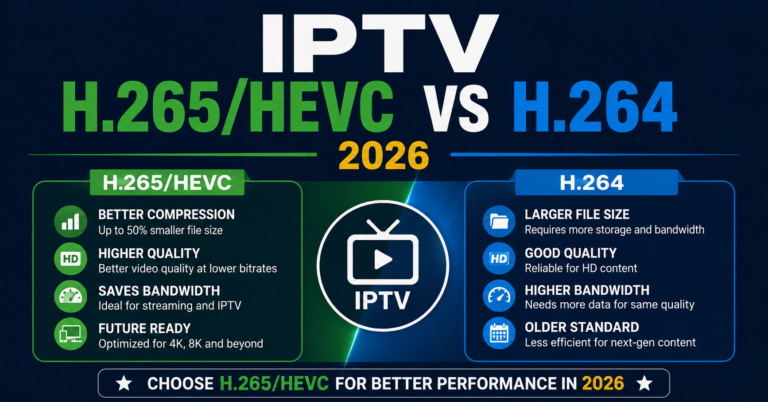
H.264 was the industry default for over a decade. At 1080p, it’s workable. At 4K, it’s a liability. A clean 4K H.264 stream demands 25–40 Mbps to look watchable. HEVC (H.265) delivers equivalent or better quality at 12–18 Mbps — roughly half the bandwidth.
For a reseller running 200+ active lines on a 1Gbps uplink, that difference is the gap between a stable panel and a panel in permanent buffering crisis.
Why most resellers ignore the encoder tier:
- They rely entirely on upstream provider quality
- They assume panel credits and server location are the only variables
- They’ve never traced a buffering complaint back to codec inefficiency
Pro Tip: If your 4K streams buffer only during high-motion content — fast panning, crowd scenes, rapid cuts — and your server CPU is fine, the problem is almost certainly bitrate management at the encoder level, not your infrastructure.
HEVC Encoding Efficiency: The Formula That Resellers Need to Know
Before you commit to 4K HEVC SDI to IPTV Encoder hardware or an upstream provider’s encoding spec, run this calculation. It tells you whether your uplink can actually sustain your active line count at 4K HEVC quality.
Required Bandwidth Formula:
Btotal=N×Bstream×(1+Ooverhead)B_{total} = N \times B_{stream} \times (1 + O_{overhead})
Where:
- BtotalB_{total} = Total bandwidth required (Mbps)
- NN = Number of simultaneous active 4K lines
- BstreamB_{stream} = Per-stream bitrate in Mbps (target: 15 Mbps for HEVC 4K)
- OoverheadO_{overhead} = Protocol overhead factor (typically 0.15 for HLS/UDP)
Example: 100 active 4K lines × 15 Mbps × 1.15 = 1,725 Mbps required
In 4K HEVC SDI to IPTV Encoder If your server sits on a 1Gbps uplink, you’re already over capacity before accounting for any 1080p lines running in parallel. This is why UK-based 10Gbps+ uplink servers are non-negotiable for any reseller operating at 4K scale — and why platforms like Smart IPTV Reseller that are built on high-capacity UK infrastructure give you a structural advantage before you’ve written a single line of panel config.
SDI Input Standards: 3G-SDI vs 12G-SDI for 4K Broadcast
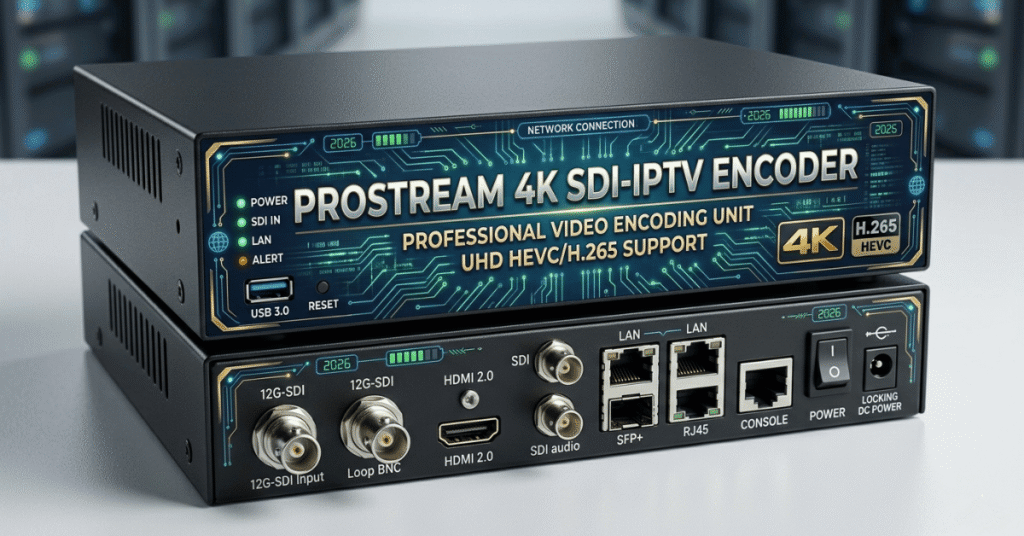
Not all SDI inputs are equal. This is a detail that catches out resellers moving into the professional broadcast tier for the first time.
| SDI Standard | Max Resolution | Max Frame Rate | Use Case |
|---|---|---|---|
| SD-SDI | 480i / 576i | 25/30fps | Legacy only |
| HD-SDI | 1080i / 720p | 60fps | Standard HD |
| 3G-SDI | 1080p | 60fps | HD broadcast |
| 6G-SDI | 4K UHD | 30fps | 4K single-link |
| 12G-SDI | 4K UHD | 60fps | Full 4K broadcast |
If your source hardware outputs 12G-SDI and your encoder only accepts 3G-SDI, you’re not encoding 4K — you’re downscaling to 1080p before the signal ever reaches the codec. I’ve seen resellers pay a premium for “4K HEVC” upstream feeds and receive 1080p upscaled content because nobody checked the SDI handshake at ingestion.
For professional broadcast solutions in 2026, your 4K HEVC SDI to IPTV Encoder must support 12G-SDI input to guarantee genuine 4K60 signal ingestion. Anything less and you’re marketing 4K to customers while delivering a lie.
HLS Latency Optimisation in 4K HEVC SDI to IPTV Encoder Pipelines
Once your 4K HEVC SDI to IPTV Encoder has done its job — ingested the SDI signal and compressed it into HEVC — the output needs to travel through your delivery pipeline without accumulating latency. This is where most 4K pipelines quietly fall apart.
Standard HLS segment lengths run at 6–10 seconds. For live 4K sport, that means a viewer can be watching content that’s 10–30 seconds behind real time by the time buffering, CDN propagation, and client-side pre-caching are factored in. For commentary synchronisation and second-screen use, that’s a significant problem.
Low-latency HEVC HLS optimisation steps:
- Set segment duration to 2 seconds maximum
- Enable chunked transfer encoding on your origin server
- Use LL-HLS (Low Latency HLS) spec if your encoder firmware supports it
- Deploy a UK-based CDN edge node — trans-Atlantic routing adds 80–120ms by default
- Confirm your encoder outputs constant bitrate (CBR) rather than variable (VBR) for stable segmentation
Pro Tip: LL-HLS with 2-second segments on a 4K HEVC stream will push your origin server harder than standard HLS. Benchmark your server’s CPU and I/O before rolling it to your full subscriber base — do it on a 10-line test group first and monitor buffer-bloat metrics for 48 hours.
AI-Driven ISP Detection in 2026: Why Encoder Fingerprinting Matters
In 4K HEVC SDI to IPTV Encoder UK ISPs have significantly advanced their deep packet inspection capabilities through 2025 and into 2026. Machine learning models now profile stream behaviour — segment timing, bitrate variance patterns, codec signatures — rather than relying solely on DNS poisoning or IP blacklisting. This means the encoder’s output fingerprint is itself a detection vector.
What AI-based ISP inspection targets:
- Consistent HEVC segment timing (a giveaway of automated encoding pipelines)
- Predictable bitrate ceiling (flat CBR streams are easier to classify)
- Repeated GOP (Group of Pictures) structure across multiple subscribers on the same IP block
Mitigation is not about breaking the codec — it’s about introducing controlled variance. Encoders with adaptive bitrate laddering and dynamic GOP length randomisation produce streams that look statistically closer to legitimate OTT delivery. Several professional-grade HEVC encoder platforms now include ISP evasion profiles as a configurable option.
This is an arms race. Operators running static CBR HEVC pipelines that haven’t been reviewed since 2024 are operating with a detection surface that has grown considerably larger.
Reseller Success Checklist: 4K HEVC SDI to IPTV Encoder
- Verify your SDI input standard — confirm 12G-SDI compatibility on both source hardware and encoder before purchasing any 4K upstream feed
- Run the bandwidth formula — calculate BtotalB_{total} against your actual uplink capacity before scaling active 4K lines beyond 50
- Set segment duration to ≤2 seconds — implement LL-HLS across your 4K delivery pipeline and monitor buffer-bloat for 48 hours post-deployment
- Audit your encoder’s ISP evasion capability — check for adaptive bitrate laddering and dynamic GOP configuration; static CBR is a 2026 detection risk
- Anchor your infrastructure on a UK 10Gbps+ platform — encode locally, deliver locally; Smart IPTV Reseller provides the panel infrastructure to support high-capacity 4K reseller operations without routing penalties
Smart IPTV Reseller provides panel management software for IPTV resellers. The platform does not host, distribute, Smart IPTV Reseller or stream any media content. Resellers are solely responsible for ensuring compliance with applicable laws in their operating jurisdiction.