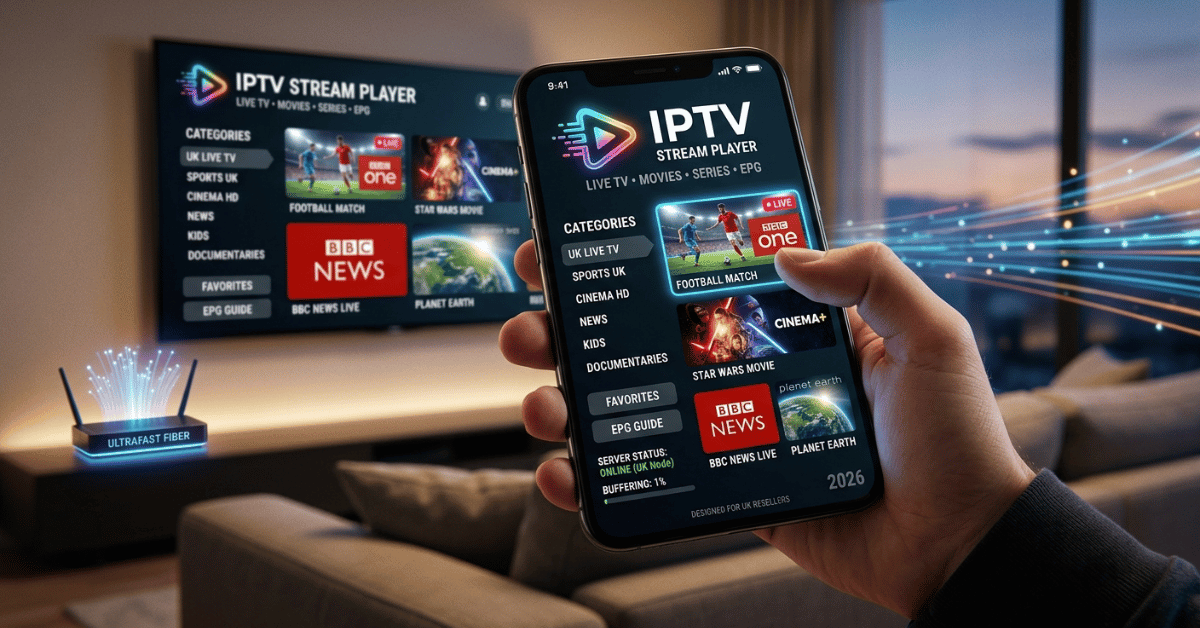
IPTV Stream Player Guide: Why the App Your Customers Use Matters More Than You Think
It was a Saturday. 12:58 PM. I had 340 active lines on my panel, a freshly onboarded batch of 60 new subscribers, and a provider who’d promised “99.9% uptime.” By 3:05 PM, my WhatsApp was a graveyard of buffering screenshots. Every single one of them had a different IPTV stream player, TiviMate, IPTV Smarters, VLC, GSE, and every single one was choking on the same dying feed.
That day taught me something the reseller forums never say out loud: the IPTV stream player is not the problem. It never is. But it’s always the first thing your customers blame. And if you don’t understand how each IPTV stream player interacts with your panel’s output, your infrastructure, and your provider’s delivery method, you will keep losing subscribers to a problem you don’t even know how to diagnose properly.
This article is for UK IPTV Panel resellers who are serious about retention, serious about scale, and done with guessing.
Why the IPTV Stream Player You Recommend Changes Everything
Most resellers hand out M3U links and call it a day. That’s the mistake. The IPTV stream player a customer uses directly affects how your streams are requested, buffered, and re-requested when a packet drops. Different players handle HLS latency differently. Some aggressively retry on timeout. Others just freeze.
TiviMate, for example, uses a pre-buffer system that pulls ahead of the live stream by a few seconds, ideal for stable 4K HEVC content, but punishing on unstable providers because it amplifies micro-drops into visible freezes. IPTV Smarters Pro, by contrast, uses a lighter buffer model that’s more forgiving on weaker connections but can stutter on high-bitrate streams above 25 Mbps.
As a reseller, understanding the IPTV stream player behaviour of each app means you can troubleshoot faster, reduce support tickets, and actually advise your customers rather than just sending them a tutorial link.
Pro Tip: Always ask new customers which IPTV stream player they’re using before you assign them a line. Player type affects which connection profile you should provision, lightweight apps get standard lines, buffer-heavy players need premium low-latency connections.
IPTV Stream Player Compatibility Across UK Devices
The UK market is dominated by Firestick, Android boxes, and Smart TVs, and not every IPTV stream player runs cleanly on all three. This is where a lot of IPTV resellers create friction without realising it.
| Device | Recommended IPTV stream player | Notes |
|---|---|---|
| Amazon Firestick | TiviMate, IPTV Smarters Pro | Sideload required for TiviMate |
| Android TV Box | TiviMate, GSE Smart IPTV | Full EPG support available |
| Samsung Smart TV | SS IPTV, Smart IPTV | Limited compared to Android players |
| iOS (iPhone/iPad) | GSE Smart IPTV, IPTV Smarters | Apple restrictions apply |
| MAG Box | Built-in Stalker Portal | Requires MAC-based provisioning |
| PC/Windows | VLC, Kodi with PVR Plugin | High-bitrate streams handle well |
The point here isn’t to memorise this table, it’s to understand that when you’re running a panel with 500+ lines, the IPTV stream player distribution across your customer base shapes your infrastructure requirements. A customer base dominated by TiviMate users on Firestick behaves very differently at peak time than one dominated by MAG box Stalker connections.
How Player Requests Actually Load Your Panel
This is the technical layer most resellers ignore completely. When a customer opens their IPTV stream player and loads a channel, what actually happens?
The player sends an authentication request to your panel, either via Xtream Codes API or M3U URL, retrieves the playlist, then opens a persistent stream connection. The panel logs a concurrent connection. If your customer’s IPTV stream player crashes or the app is backgrounded on a Firestick, some players (TiviMate especially) maintain the session, consuming your concurrent allowance even when no one’s actively watching.
This is why your concurrent count can show 400 active connections during off-peak hours when you’ve only got 280 subscribers. Ghost connections from idle IPTV stream player sessions silently eat your panel’s capacity.
Session Efficiency Formula:
- Real Active Load = (Total Concurrent Connections) − (Ghost Sessions from Idle IPTV Stream Players)
- Ghost Session Rate (%) = (Idle Connections ÷ Total Connections) × 100
If your ghost session rate is above 20%, your panel is operating at false capacity, and peak-time load will hit much harder than your numbers suggest.
Choosing the Right IPTV Stream Player for 4K Delivery
Running 4K HEVC streams through the wrong IPTV stream player is like pushing water through a garden hose at mains pressure. The app has to decode HEVC in real time, manage the buffer without overwhelming RAM, and maintain a clean HLS connection, all simultaneously. On mid-tier hardware, this fails.
The best IPTV stream player for 4K delivery in the UK market right now:
- TiviMate Premium: Handles HEVC decode well on Firestick 4K Max; EPG integration is excellent
- GSE Smart IPTV: Solid on Android boxes with dedicated GPU decoding enabled
- Kodi with PVR IPTV Simple Client: Best for advanced users who want granular buffer control settings
- IPTV Smarters Pro: Acceptable for 1080p; struggles above 35Mbps on budget Android hardware
One thing I’ve learnt managing premium-tier subscribers: if your IPTV stream player recommendation doesn’t match the customer’s hardware, 4K sells itself as a downgrade. They see buffering and assume your provider is rubbish. The stream was fine. The player was wrong.
Pro Tip: For customers on Firestick 4K or 4K Max devices, always provision them on your lowest-latency server profile and recommend TiviMate as the IPTV stream player of choice. The combination reduces buffering complaints by a significant margin on high-bitrate content.
ISP Blocking and How Your Streaming App Handles It
In 2026, ISP-level blocking in the UK has become sophisticated. Major ISPs are running AI-pattern recognition on stream request signatures, the way an IPTV stream player makes repeated API calls, the request headers it sends, and the connection cycling pattern it uses are all becoming fingerprinting vectors.
Some IPTV stream player apps send naked Xtream Codes requests with consistent user-agent strings, easy to flag. Others rotate headers, use HTTPS by default, and obscure connection patterns. This matters because if your provider’s servers start getting flagged, the player your customers use can accelerate or slow down the detection.
The current recommendation for ISP-resilient setups:
- Use HTTPS delivery endpoints (your provider should offer this without exception)
- Recommend players that support custom user-agent strings
- Pair with panels on servers hosted outside flagged UK IP ranges
Platforms like Smart IPTV Reseller have built their infrastructure around exactly these concerns, UK-optimised routing, 10Gbps+ uplinks, and delivery endpoints designed to survive ISP-level filtering. When you’re choosing where to run your reseller panel, the IPTV stream player compatibility of your backend matters as much as the front-end app.
Read More: IPTV Reseller Panels
IPTV Stream Player Setup: What Resellers Should Be Sending Customers
A poor setup guide costs you subscribers. The best resellers treat the IPTV stream player onboarding process like a product in itself.
Here’s what a proper customer setup flow looks like:
- Identify device first, never send a generic guide
- Recommend the correct IPTV stream player for that device from your approved list
- Send a pre-filled M3U or Xtream Codes setup, don’t make them copy credentials manually
- Include a one-page troubleshooting guide specific to that player
- Follow up within 24 hours, confirm the stream is loading cleanly before they have a reason to complain
This flow alone, applied consistently, will reduce your first-week churn significantly. Most customers who cancel in week one do so because the IPTV stream player wasn’t set up correctly, not because they didn’t like the content.
Reseller Success Checklist: IPTV Stream Player Edition
- Identify your customer base’s primary devices and match recommended IPTV stream player accordingly
- Monitor ghost sessions on your panel and set idle-disconnect thresholds to manage real concurrent load
- Provision 4K subscribers on low-latency profiles and confirm player HEVC compatibility before upselling
- Ensure your provider delivers via HTTPS endpoints to reduce ISP fingerprinting exposure across all player types
- Build a device-specific setup guide library, one guide per IPTV stream player app you support, and use it as your standard onboarding pack