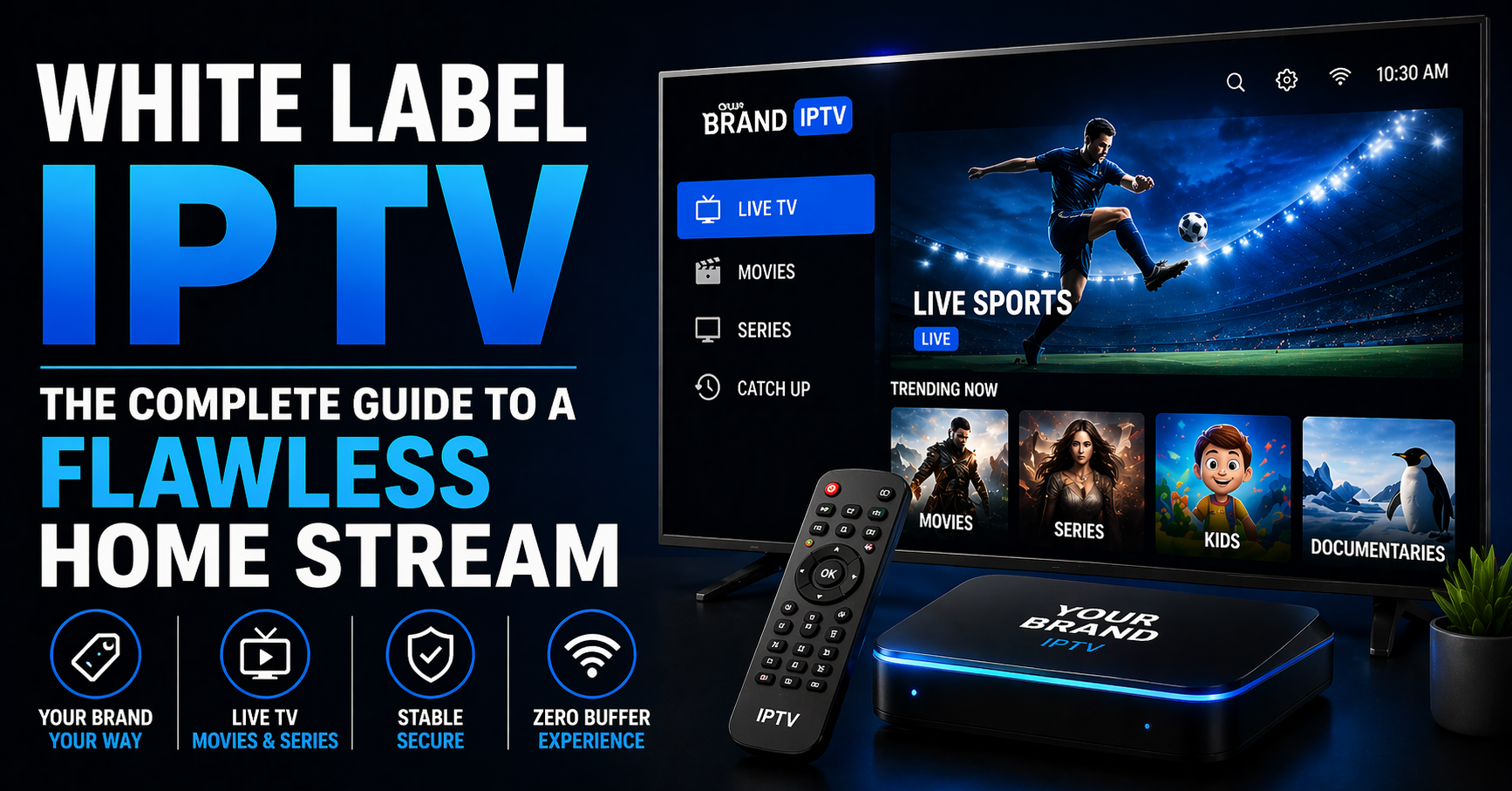
There’s a specific kind of frustration that hits when the picture freezes at exactly the wrong moment. You’ve planned the evening. The snacks are ready. And then — the spinning wheel. If you’re running a white label IPTV setup at home, that moment doesn’t have to happen. Not if your network is ready.
This guide White Label IPTV is not about finding content. It’s about making sure your delivery system never lets you down.
What White Label IPTV Actually Means for the Home Viewer
Most people interact with white label IPTV without knowing the name behind it. When a service provider builds a streaming platform under their own brand — their own logo, their own app, their own interface — but uses another company’s infrastructure underneath, that’s white label IPTV at work.
For the viewer sitting on the couch, what matters is this: the experience is customized, the branding feels familiar, and the performance depends entirely on how well the underlying system was configured. A well-built white label IPTV deployment is invisible. You just watch. A poorly configured one? That’s where the buffering lives.
Understanding this distinction changes how you troubleshoot. The problem is rarely your content. It’s usually your connection or your device’s conversation with the delivery layer.
The Night the Fish Tank Nearly Ruined Everything
I’ll be honest about something. A couple of years back, I was helping a friend set up a white label IPTV service he’d just subscribed to. He wanted to watch a major boxing event in 4K. I placed the router on a shelf — right behind his living room fish tank. A 55-gallon freshwater setup, full of gravel and driftwood and water.
The first round was fine. By the third, the stream was stuttering every time the crowd noise spiked. We couldn’t figure it out for nearly twenty minutes.
Water absorbs Wi-Fi signals. A full fish tank between your router and your TV is effectively a wall made of signal interference. Once we moved the router six feet to the left, the stream locked in at full quality and never dropped again.
The lesson wasn’t technical. It was spatial. White label IPTV performs as well as the physical path between your router and your screen. Clear that path first.
Why High-Action Moments Always Seem to Break the Stream
It’s not a coincidence that the picture goes soft or freezes right when something important happens. Here’s the honest explanation.
Live or high-motion content encodes more data per second during fast action. A quiet scene in a drama uses maybe 4–6 Mbps. A stadium crowd shot, an explosion, or a fast-moving sports play can spike to 15–20 Mbps in a fraction of a second. If your connection can deliver 18 Mbps on average but dips to 11 during household peak hours, the stream doesn’t have enough buffer to absorb the spike.
Think of your home internet like a water pipe. Most of the time, the flow is fine. But when someone turns on the dishwasher, runs a shower, and opens the sprinklers at the same time, the pressure drops. White label IPTV is asking for a consistent pressure. Not necessarily high pressure — just stable.
That’s the real enemy. Not speed. Stability.
The Invisible Congestion Problem on Your Own Network
Your router is managing a small city of devices. Phones. Laptops. Smart TVs. Tablets. Security cameras. Each one is sending and receiving data constantly, even when it looks idle.
Wi-Fi bands work like lanes on a highway. The 2.4GHz band is the old two-lane road — it carries farther but moves slower, and every other device in your neighborhood is probably using it. The 5GHz band is the express lane — faster, shorter range, far less congested.
For white label IPTV to perform at its best, your streaming device should be on the 5GHz band. Or better yet, connected via ethernet cable directly to the router. A wired connection removes Wi-Fi from the equation entirely.
If you’re managing access for multiple households or a large family, understanding how an IPTV Reseller Panel structures accounts can help you avoid login conflicts during high-demand moments when multiple users hit the server simultaneously.
Optimal Viewing Settings for Action Content
White label IPTV services often deliver a wider picture quality range than people realize. But the TV itself can undo all of that if the settings are wrong.
Contrast Ratio and Black Crush
Action content — combat sports, high-speed racing, thriller films — lives in contrast. The difference between a properly calibrated display and an out-of-box TV is often the contrast settings.
“Black crush” happens when dark areas of the picture collapse into a single flat black. You lose shadow detail. A fighter’s corner of the ring disappears. A night chase sequence becomes a formless black screen with moving shapes.
To fix this, go into your TV’s picture settings and look for “Black Level” or “Shadow Detail.” Most TVs ship with this set too high. Reduce it until you can distinguish between dark grey and true black in the same frame. Then your white label IPTV stream will show you what the encoder actually captured.
Also disable “Motion Smoothing” — often labeled as TruMotion, MotionFlow, or Auto Motion Plus depending on your brand. It adds fake frames and makes fast content look like a daytime soap opera.
Center Channel and Dialogue Clarity
If your viewing is more drama-focused, the audio setup matters as much as the picture. Most white label IPTV streams deliver stereo or Dolby audio, but on a flat TV’s built-in speakers, dialogue gets buried under music and effects.
Boosting the center channel — either through a soundbar’s settings or your TV’s audio EQ — pulls voices forward. You won’t need subtitles anymore.
Your Pre-Stream Checklist for a Flawless Evening
Don’t wait until the stream starts to find a problem. Run through this at least an hour before you plan to watch.
Table 1: Troubleshooting Flow Chart
| Symptom | Likely Cause | The Fix |
|---|---|---|
| Picture looks fuzzy only during crowd or action shots | Low bitrate during encoder spike | Switch from Auto to Manual Quality — select 1080p fixed |
| Stream pauses every 2–3 minutes | Insufficient RAM on device | Close all background apps, restart the streaming device |
| Audio and video are out of sync | Buffering causing playback delay | Lower the stream quality by one step, then re-sync |
| Stream works on phone but not TV | TV is on 2.4GHz band | Switch TV to 5GHz network or use ethernet cable |
| App loads but stream won’t start | Cached credentials or expired session | Log out fully, clear app cache, log back in |
Table 2: Event Prep Timeline
| Time Before the Event | Action Item |
|---|---|
| 1 Week Before | Test your stream at the same time of day the event will air — peak hour traffic varies |
| 2 Days Before | Update your streaming app and device firmware |
| 1 Day Before | Run a speed test and confirm 5GHz or ethernet connection is active |
| 2 Hours Before | Close unused apps and background downloads on all household devices |
| 1 Hour Before | Restart your router and streaming device — this clears memory cache and refreshes your IP connection |
| 15 Minutes Before | Load the stream, let it buffer briefly, then pause — this pre-loads the pipeline |
Cable vs. Modern Streaming: An Honest Side-by-Side
This comparison gets emotional for some people. Let’s just look at the numbers.
| Category | Traditional Cable | White Label IPTV Setup |
|---|---|---|
| Monthly Cost | $80–$180 (bundled with channels you don’t watch) | Varies — typically lower for targeted subscriptions |
| Installation | Technician required, fixed hardware | App-based, self-installed on most devices |
| 4K Availability | Limited, often upcharge | Widely available depending on service |
| Flexibility | Channel packages, limited customization | On-demand, genre-specific, multi-device |
| Reliability | Consistent but weather-dependent | Depends on internet stability |
| Contract | Often 12–24 months | Usually monthly or flexible |
Cable wins on consistency. Modern white label IPTV wins on flexibility and value. The real answer for most households is stable internet plus a well-configured streaming setup.
While the cost of a single pay-per-view event through traditional cable remains high, it is worth comparing the value on our Pricing Page for the tools that keep the stream steady.
Things People Get Wrong About Streaming Quality
“I need gigabit internet for 4K.”
No. 4K HDR content typically requires 25 Mbps sustained. What you actually need is a stable 25 Mbps — meaning that number doesn’t drop below 20 during peak hours. A 100 Mbps connection that fluctuates between 8 and 95 is worse than a 50 Mbps connection that holds at 48. Stability beats raw speed every time when it comes to white label IPTV.
“Buffering means the service is bad.”
Sometimes. But more often, buffering is a local network problem. The stream left the server cleanly. It degraded somewhere between your router and your screen.
“Live streams always lag. That’s just how it is.”
The latency on a properly configured white label IPTV delivery system is typically 3–8 seconds behind real-time. That’s acceptable for most live content. If you’re seeing 30+ second delays, your device’s buffer settings or your network’s packet loss is the issue — not the stream itself.
“Restarting the app fixes everything.”
Restarting the app clears the application layer. But if the problem is router congestion or band interference, the app restart changes nothing. Restart the router and the device. That’s the full reset.
FAQs
Is white label IPTV legal?
White label IPTV as a technology and business model is entirely legal. It refers to the practice of a company branding and distributing a streaming platform built on third-party infrastructure — the same model used by many legitimate telecom and media companies worldwide. What matters is whether the content being delivered through any IPTV system is properly licensed. This guide is about the method of delivery and home optimization, not the source of the content. Always ensure that any service you subscribe to holds the appropriate rights for the content it distributes.
Do I need a special device for white label IPTV?
Most white label IPTV platforms are compatible with Android TV boxes, Amazon Fire Stick, Apple TV, and smart TVs with app support. No specialized hardware is required in most cases.
Why does my stream quality drop in the evening?
Evening hours — roughly 7 PM to 10 PM — are peak internet usage times in most residential areas. Your internet service provider’s local infrastructure gets congested. This is called “network congestion at the ISP level,” and it affects everyone in your area simultaneously. The fix is to use a wired connection, which reduces the local competition for bandwidth within your home.
Can multiple people use the same white label IPTV account?
This depends entirely on the service’s terms. For those curious about the backend management of multi-user access, this is similar to What Is an IPTV Reseller Panel — it’s the dashboard for organizing user credentials, which ensures your specific connection is unique and less prone to being kicked off during high traffic periods.
What’s the best resolution to stream at?
If your connection is stable at 25 Mbps or above, stream at 1080p or 4K with the quality set to manual rather than auto. Auto quality adjusts dynamically and often drops right at the worst possible moment. Fix it high and let the buffer absorb minor fluctuations.
The Bottom Line
A great viewing experience doesn’t come from luck. It comes from a router in the right place, a device on the right band, and a service that was configured properly from the start.
White label IPTV, when set up correctly, is one of the most flexible and cost-effective ways to watch what you want, when you want it, on a screen that does it justice. The technology is solid. What usually fails is the five feet of Wi-Fi between the router and the TV.
Fix the path. Test before the moment. Restart before you need to. And move the router away from the fish tank.
This article is a technical guide about home network optimization and streaming delivery methods. It does not represent, promote, or facilitate access to any unlicensed or copyrighted content. White label IPTV refers to a legal and widely used technology framework. Any service you choose to subscribe to should be verified as properly licensed in your region.