It was 3:07 PM on a Saturday. A Champions League quarter-final. Forty-three active subscribers. And the IPTV headend went completely dark.
No warning. No failover. Just a wall of “no signal” complaints flooding WhatsApp simultaneously. That afternoon cost me three months of customer trust — built overnight, destroyed in eleven minutes. If you’ve never lived through a headend failure during peak sports traffic, consider this your education before it happens to you.
The IPTV headend is not a server. It’s not a panel. It’s the entire upstream architecture that determines whether your streams live or die under pressure. Most UK IPTV resellers never truly understand what they’re sitting on top of — until it collapses beneath them.
What an IPTV Headend Actually Is (And Isn’t)
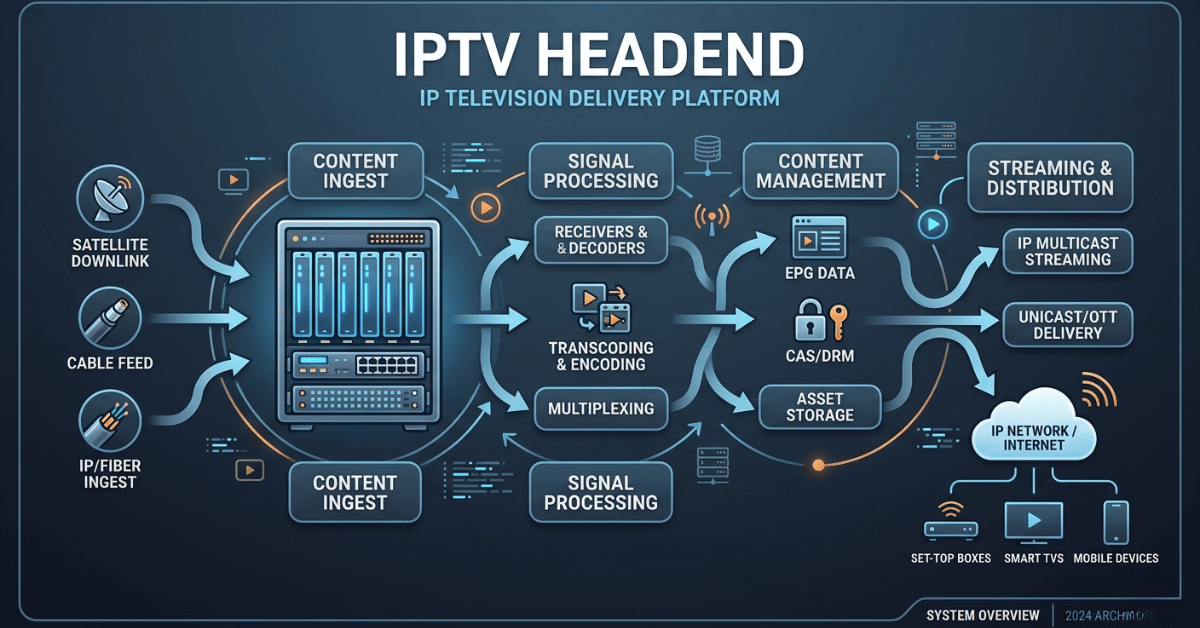
Operators throw the phrase around loosely. In practical terms, your IPTV headend is the centralised signal acquisition, encoding, and distribution hub that processes every channel before it reaches your subscribers. It ingests satellite feeds, manages transcoding pipelines, applies encryption, and pushes output across CDN nodes or direct HLS delivery paths.
What it isn’t: a reseller panel. A panel is just a management interface sitting downstream of the headend. Confusing the two is like calling a cash register a warehouse. The panel shows you credits and connections; the IPTV headend is the engine room entirely.
In a proper UK-facing setup, the headend should sit on a minimum 10Gbps uplink, preferably colocated in a Tier 3 data centre with sub-15ms latency to major British internet exchange points. Anything less and you’re already compromised before a single subscriber connects.
Pro Tip: Don’t let any provider claim their IPTV headend is “UK-based” without asking specifically which IXP they peer at. Peering at LINX (London Internet Exchange) versus a generic EU hub makes a measurable difference to buffer-bloat during peak hours.
Why Headend Architecture Determines Your Churn Rate
This is the conversation nobody wants to have with their reseller because it requires admitting that most cheap IPTV packages are downstream from the same three or four poorly maintained IPTV headend clusters — all of them oversold, all of them bottlenecked by Saturday afternoon.
Customer churn in the UK IPTV reseller market is overwhelmingly driven by one thing: inconsistent stream quality during premium sports windows. Your subscribers aren’t leaving because your price is wrong. They’re leaving because the IPTV headend feeding their streams can’t handle concurrent 4K HEVC sessions without introducing HLS latency spikes that kill the experience.
The psychology here matters enormously. A subscriber who experiences two buffering incidents in three months will mentally classify your service as unreliable — regardless of the 27 perfect days in between. This is called the peak-performance memory bias, and it absolutely wrecks retention figures for resellers who haven’t invested upstream.
| Infrastructure Factor | Budget Headend | Premium IPTV Headend |
|---|---|---|
| Uplink Capacity | 1Gbps shared | 10Gbps+ dedicated |
| Redundancy | Single point | Multi-node failover |
| HLS Latency (peak) | 8–14 seconds | 2–4 seconds |
| 4K HEVC Support | Partial / unstable | Full transcode pipeline |
| ISP Block Resistance | Low | High (IP rotation + DNS) |
The ISP Blocking Problem Nobody Explains Honestly
By 2026, AI-driven ISP blocking has become the single most underestimated threat to every UK IPTV headend operator. Major UK ISPs are no longer relying solely on court-ordered IP blacklists. They’ve deployed machine-learning traffic analysis that identifies IPTV multicast and HLS stream signatures at the packet level — without needing to know the specific IP address in advance.
What this means practically: an IPTV headend that was invisible last quarter may now be flagged dynamically based on traffic pattern recognition. The old workaround of rotating IP addresses buys hours, not weeks.
The resellers who are surviving this environment share one characteristic — they’re sourcing from IPTV headend infrastructure that actively implements DNS obfuscation, HLS stream fragmentation disguise, and automated IP cycling tied to ISP blocking detection triggers. Passive infrastructure is finished. Active countermeasures are the baseline requirement now.
Pro Tip: If your provider can’t tell you how their IPTV headend responds to a DNS poisoning event within the first 60 seconds of detection, assume it doesn’t. That silence is your answer.
Smart IPTV Reseller operates specifically within this threat landscape — built for UK resellers who understand that 2026 infrastructure isn’t optional, it’s existential.
Calculating Real Headend Capacity Before You Oversell
Max Concurrent Streams=Uplink Bandwidth (Mbps)Avg Stream Bitrate (Mbps)×Overhead Factor (1.2)\text{Max Concurrent Streams} = \frac{\text{Uplink Bandwidth (Mbps)}}{\text{Avg Stream Bitrate (Mbps)} \times \text{Overhead Factor (1.2)}}
Run this before you take on another fifty subscribers. If your IPTV headend provider is running a 1Gbps uplink and averaging 8Mbps per 4K stream with a 1.2 overhead factor, you have a hard ceiling of approximately 104 concurrent streams — shared across every reseller on that node. If they’ve sold that capacity to fifteen resellers, you’re competing for 6–7 simultaneous streams during a Saturday fixture. This is not a theoretical problem. This is Saturday at 3PM.
Most resellers discover this formula after their worst downtime incident. Do the maths before you scale.
FTTP Optimisation and the Headend Connection Most Resellers Miss
The widespread UK rollout of FTTP (Fibre to the Premises) has changed subscriber expectations dramatically. Customers now sitting on genuine gigabit connections are demanding the full quality their line is capable of delivering — and they will immediately notice when an IPTV headend is throttling output because its own uplink can’t keep pace.
This creates a new pressure point for resellers. An IPTV headend that was adequate for FTTC-era subscribers at 35–50Mbps downstream is now visibly struggling against FTTP households testing 900Mbps. The gap between what the subscriber’s line can accept and what the headend can actually push becomes the buffer. Literally.
Smart resellers are already positioning with providers who have specifically upgraded their IPTV headend encoding pipelines for FTTP-era delivery — prioritising adaptive bitrate streaming that genuinely scales upward, not just marketing copy claiming it does.
Read More: IPTV Reseller Panels
Panel Management vs Headend Management — Stop Mixing Them Up
This distinction directly affects how you troubleshoot, how you communicate with providers, and how you protect your subscriber base. Your panel management responsibilities include credit allocation, connection limits, trial account handling, and client-facing uptime visibility. None of that touches the IPTV headend.
When buffering occurs, the instinct is to blame the panel or the EPG. In reality, 80% of stream quality failures originate at the IPTV headend level — encoding bottlenecks, upstream source degradation, or load balancing failures across CDN edge nodes. Knowing this changes the conversation you have with your wholesale provider and the timeline you set for resolution.
Resellers who understand the headend layer hold their providers accountable far more effectively than those who simply report “buffering issues” and wait for a generic response.
Your IPTV Headend Success Checklist
Before you take on your next batch of subscribers, run through this honestly:
- Verify uplink capacity — Confirm your provider’s IPTV headend sits on a minimum 10Gbps dedicated uplink, not shared infrastructure, and request documentation if necessary.
- Test peak-time performance specifically — Stream four simultaneous 4K channels during a major sports fixture before committing long-term. That single test reveals more than any provider SLA.
- Confirm active ISP block countermeasures — Ask explicitly how their IPTV headend responds to AI-driven traffic analysis and DNS poisoning. A credible provider answers with specifics, not reassurances.
- Run the capacity formula — Apply the concurrent stream calculation above before scaling your subscriber base. Overselling a weak IPTV headend is the fastest way to destroy your reputation.
- Partner with infrastructure built for 2026 — Platforms like Smart IPTV Reseller are specifically architected for the UK enforcement and FTTP landscape. The difference between a partner and a liability often comes down to where their IPTV headend actually sits and how it’s maintained.
The resellers still operating profitably in 2026 aren’t the ones who found the cheapest upstream. They’re the ones who understood exactly what an IPTV headend does — and refused to compromise on it.