Most people who ask how to become an IPTV reseller in 2026 are chasing the wrong number. They obsess over the price of credits. The number that actually decides whether you survive your first year is your refund rate during the second weekend of operation — because that’s when your cheap upstream provider buckles under a big match and you discover, in real time, that you bought into someone else’s failure.
I’ve watched this happen to dozens of new UK IPTV resellers. Same script every time. They sign up, undercut everyone, get forty customers in three weeks, then a Champions League night turns their WhatsApp into a wall of “buffering, refund.” Gone.
So here’s the short version before anything else.
The quick answer: Becoming an IPTV reseller in 2026 means buying panel credits from a stable provider, reselling subscriptions under your own brand, and managing support — but the part that decides your income is provider reliability, not your markup. Pick the upstream source based on uptime during peak sports traffic. Start with a small credit batch, test it through one busy weekend before you sell a single line, and treat customer retention as your real product. The barrier to entry is low. The barrier to staying is brutal.
Everything below explains why, and how to do it without becoming another three-week casualty.
What “Reseller” Actually Means Before You Spend a Cent
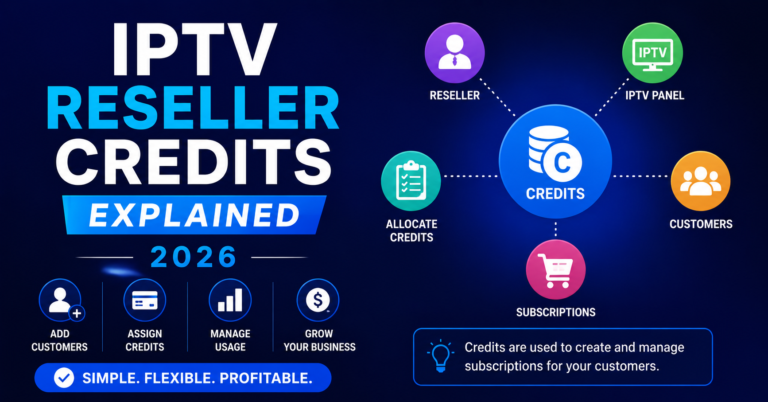
A reseller doesn’t own servers. You buy a block of panel credits from a provider’s IPTV reseller panel, and each credit converts into a subscription line you sell. The provider runs the infrastructure; you run the business — pricing, support, retention, brand.
This distinction matters because new panel owners constantly confuse the two. You are renting reliability you cannot see and cannot fix. When a stream dies at 9pm, you can’t restart a server. You can only forward the complaint upstream and wait. That dependency is the entire game.
Pro Tip: Before buying credits, ask the provider for the exact load behaviour during their busiest event last month — not uptime percentages, the actual incident log. A provider who can’t produce one has never looked. A provider who refuses one is hiding the answer.
There are three roles you’ll hear about. The IPTV operator or panel owner runs the source. The reseller (you) buys credits and sells lines. The sub-reseller buys credits from you to sell their own lines — your future distribution network, once you’re stable.
The Provider Decision Is 80% of Your Outcome
Everything else is logistics. This is the only choice that can’t be undone cheaply, because migrating customers between providers mid-subscription is how resellers quietly lose half their base overnight.
During one migration project I sat through, a reseller moved 200 lines to a “faster” panel without staggering the switch. New credentials, new app setup, all at once. Roughly 70 customers never reconfigured their devices and simply churned out of frustration. The new infrastructure was genuinely better. Didn’t matter — the transition killed the business it was meant to save.
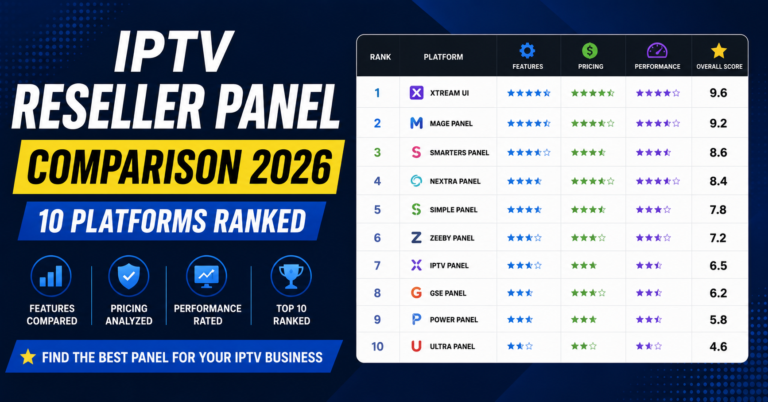
Judge an IPTV reseller panel on these, in order:
- Peak-event stability — does it hold during a major fight or final, not on a quiet Tuesday
- Failover — when one source drops, does another pick up automatically, or do channels just die
- Credit transparency — clear pricing, no surprise expiry, no silent rate hikes
- Backend honesty — can you see line status, usage, connection counts in real time
- Support latency — how fast does the provider answer you at 10pm on a Saturday
| Cheap Upstream Source | Professional IPTV Reseller Panel |
|---|---|
| One server, one country | Multiple sources, geo-routed |
| Dies during big events | Automatic failover under load |
| No backup uplink | Redundant uplinks |
| Vague or no status panel | Live line monitoring |
| Disappears when you complain | Reachable during peak traffic |
How DNS and Routing Quietly Decide Your Refunds
Most new resellers have no idea why streams stutter for some customers and not others on the same panel. Usually it’s not the panel — it’s the path between the customer and the source.
In 2026, ISPs across English-speaking markets lean hard on AI-driven traffic fingerprinting and DNS poisoning to throttle or block IPTV traffic. The stream is fine; the customer’s ISP is quietly mangling the route. A serious IPTV operator counters this with multiple domains, rotating DNS, and CDN-style routing so traffic doesn’t all funnel through one chokepoint a single ISP can target.
You can’t build this. But you must verify your provider has. Ask whether they run multi-uplink redundancy and how they respond when a major ISP starts blocking. The answer’s depth tells you who you’re dealing with.
Pro Tip: When a cluster of complaints all comes from one ISP or one city, stop blaming the panel. That’s a routing or DNS-level block, and the fix is upstream domain rotation — not a refund. Knowing this difference saves you the credits you’d otherwise burn apologising.
Setting Up the Business Layer
The technical source is rented. The business is yours to build, and it’s where most of your actual work lives. Here’s the realistic sequence.
- Test before you sell. Buy 5–10 credits. Run lines yourself across the devices your market uses — Firestick, Android TV, a Smart TV, a phone. Push them through one busy sports weekend.
- Pick a defensible price. Don’t be cheapest. Cheapest attracts churners and price-shoppers who leave the moment someone’s a pound cheaper.
- Brand it. A clean storefront, a real domain, a WhatsApp Business number. Customers trust a name over a faceless Telegram handle.
- Build a support flow before customers arrive, not after. Templated setup guides per device cut your ticket volume in half.
- Then scale credits in proportion to what you can actually support.
Pro Tip: Your first 20 customers are unpaid QA. Treat them like a focus group — every confused setup question is a guide you haven’t written yet. Resellers who skip this stay stuck answering the same five questions forever.
The Money Reality Nobody Advertises
Margins are thinner than the forums suggest. After refunds, churn, and the time support eats, a credit reseller’s real profit on a single line is modest. The income is in volume and retention, not markup.
Here’s a frustration worth naming: most IPTV business owners measure success by signups. Wrong metric. After reviewing hundreds of support patterns, the resellers who lasted weren’t the ones acquiring fastest — they were the ones whose customers stopped leaving. A reseller adding 30 and losing 25 monthly is running on a treadmill. One adding 15 and losing 3 is building something.
| Vanity Metric | Metric That Pays |
|---|---|
| Total signups | Net retained after 60 days |
| Lowest price | Lowest refund rate |
| Credit volume bought | Credits actually activated |
| Followers / group size | Repeat renewals |
Where Sub-Resellers Fit — and When
Once your base is stable, you can become a panel owner to others. Sub-resellers buy panel credits from you, sell their own lines, and handle their own customers. It multiplies reach without multiplying your support load — in theory.
In practice, a bad sub-reseller damages your reputation, because the line traces back to your IPTV distribution network. Vet them. One reseller I know onboarded sub-resellers indiscriminately, and a single careless one generated enough chargebacks to threaten the whole upstream relationship.
Build the sub-reseller layer when:
- Your own churn is under control
- Your support is documented and repeatable
- You can afford to lose a sub-reseller without it hurting cash flow
- You’ve got a way to monitor their line quality, not just take their money
Frequently Asked Questions
How do I become an IPTV reseller in 2026 with no technical background?
You don’t need to run servers. To become an IPTV reseller in 2026 you buy panel credits from a provider, sell subscription lines under your brand, and handle customer support. The technical infrastructure is the provider’s job. Your real skills are reliability vetting, clear communication, and retention — none of which require coding.
How much money do I need to start?
Less than most expect — a small batch of panel credits, a domain, and a WhatsApp Business number can start you for very little. The mistake is spending it all on credits. Reserve budget for refunds and a buffer, because your first busy weekend will test both your provider and your patience.
Why do customers leave even when my streams work?
Often it’s ISP-side throttling or DNS poisoning affecting specific networks, not your panel. Other times it’s a clunky setup experience. Churn is rarely about price. Customers leave friction and unreliability, so fixing onboarding and provider stability retains more than any discount ever will.
Is it still worth becoming an IPTV reseller in 2026?
Becoming an IPTV reseller in 2026 can still work, but the easy-money era is over. ISP blocking is smarter, customers expect reliability, and margins reward operators who retain rather than churn. It’s a real business now — viable for those treating it seriously, punishing for those chasing quick wins.
What’s the biggest mistake new resellers make?
Choosing a provider on price alone. A cheap IPTV reseller panel that collapses during a big match costs you far more in refunds and reputation than the credits ever saved. Pick the upstream source on peak-event stability first, price second.
Can I sell to other resellers?
Yes — once stable, you become a panel owner and onboard sub-resellers who buy credits from you. Wait until your own retention and support are solid. A careless sub-reseller in your IPTV distribution network can generate chargebacks and complaints that trace straight back to your reputation.
The Honest Conclusion
If you want one sentence on how to become an IPTV reseller in 2026: rent reliability you’ve personally verified, build a brand around it, and obsess over keeping customers rather than counting them. The credits are cheap. The trust is expensive, and it’s the only thing you actually sell.
The resellers who survive past year one treat this like infrastructure, not arbitrage. They test before selling, choose providers on peak-event behaviour, and document their support until tickets shrink. If you want a sense of what a stable, properly-branded UK IPTV reseller operation looks like in practice, studying an established storefront like britishreseller.com is more instructive than any forum thread. Becoming an IPTV reseller in 2026 is still a real opportunity — for the patient.
Action Checklists
For Subscribers (before you buy from any reseller):
- Ask for a short trial across your actual device
- Test it during a live sports event, not a quiet hour
- Confirm setup support exists before paying
- Check there’s a real contact channel, not a dead Telegram
For New Resellers:
- Buy 5–10 credits and self-test before selling anything
- Verify provider failover and peak-event stability
- Write per-device setup guides up front
- Set a defensible price, not the lowest
- Track refund rate and 60-day retention weekly
For Sub-Resellers:
- Confirm your upstream reseller’s own stability first
- Get clear credit pricing and expiry terms in writing
- Don’t oversell beyond what you can support
- Keep your own setup documentation, don’t rely on the panel owner’s
- Monitor your line quality during big events
A final thought worth keeping: in this business, the cheapest provider and the most expensive lesson are usually the same thing. Verify reliability before you ever take a customer’s money, because every line you sell is a promise made on infrastructure you don’t control — and your reputation is the collateral.
Note: reselling IPTV services carries legal and licensing considerations that vary by country. Make sure any service you resell holds the proper distribution rights in your target markets.