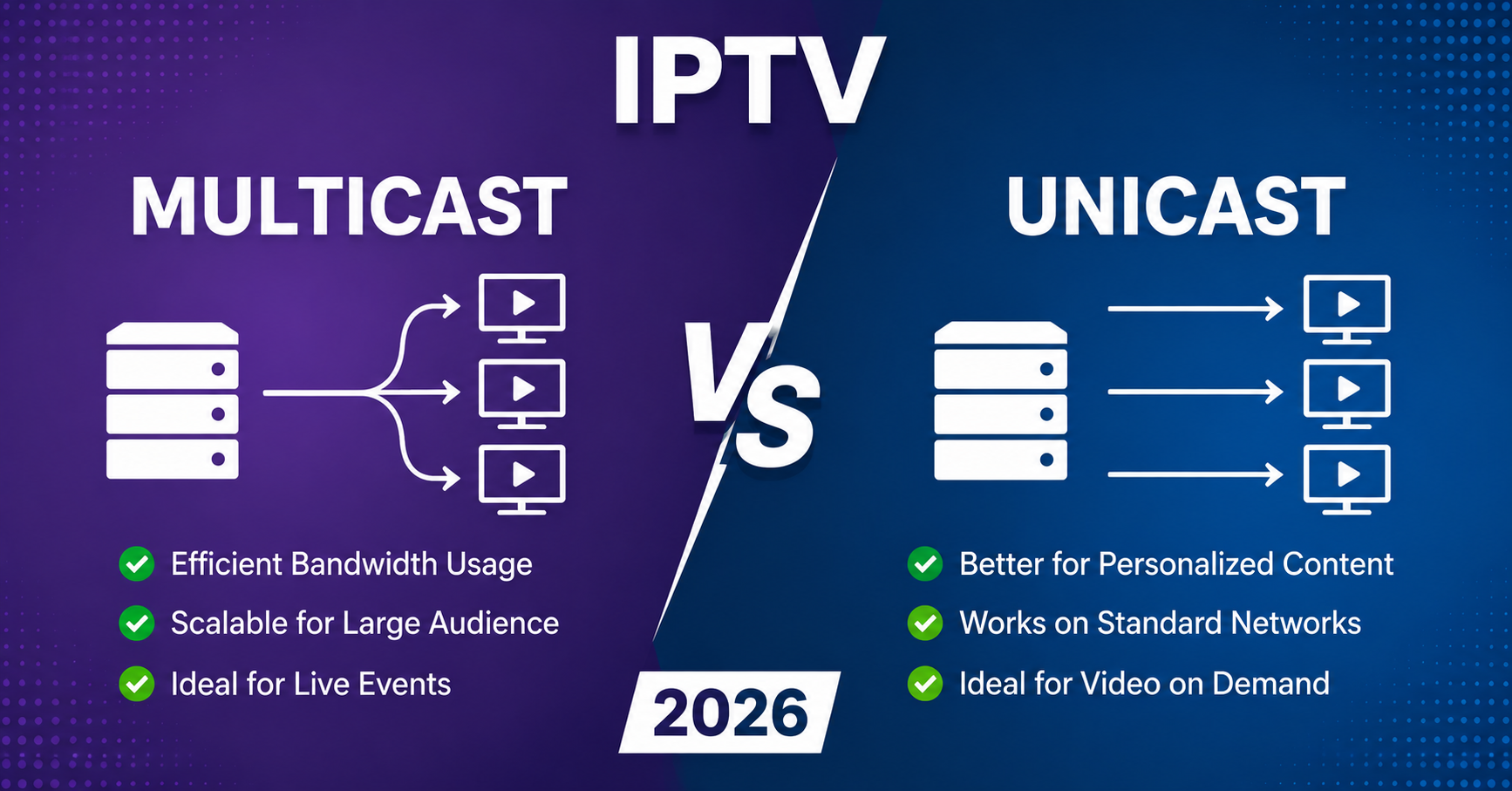
IPTV Multicast vs Unicast 2026: What Resellers Must Know
A reseller messaged me last winter, furious. His panel had crawled to a stop during a Saturday football slate. Same servers that handled a quiet Tuesday without breaking a sweat. He blamed the provider, threatened to switch, the whole routine. The real culprit wasn’t the provider at all. It was a delivery model mismatch he’d never thought about, because nobody had ever explained it to him in plain language.
That conversation is why this exists.
The short version, before anything else
If you run an IPTV reseller business serving customers spread across different homes, cities, and countries, you are almost certainly relying on unicast delivery, whether you know it or not. Multicast, the thing people romanticise in technical forums, barely works across the public internet. So when you compare IPTV multicast vs unicast 2026 as a reseller, the honest answer is that unicast is your reality and your job is to engineer around its weaknesses, not chase a multicast dream that your customers’ ISPs will never honour.
The likely cause of that Saturday meltdown? Every viewer pulling an individual stream at once, with no infrastructure built to absorb the spike. The fix isn’t switching delivery models. It’s redundancy, smarter routing, and capacity planning. Everything below explains why.
What these two words actually mean for a stream
Strip away the diagrams. Unicast means one viewer, one dedicated stream. A thousand customers watching the same channel means a thousand separate copies flowing out of your servers. Multicast means one stream sent once, and the network itself duplicates it only where it needs to branch toward viewers. One copy serves everyone on that path.
On paper, multicast wins on efficiency by a landslide. A single channel reaching ten thousand homes costs almost the same bandwidth as reaching ten. That’s the dream resellers hear about and assume they’re missing out on.
Here’s the catch that the dream conveniently skips.
Why multicast quietly dies on the open internet
Multicast needs every router between your source and the viewer to cooperate. Inside a controlled network, like a telecom company delivering TV to its own subscribers over its own fibre, that cooperation exists. The operator owns every box in the path.
Your customers don’t live inside your network. They sit behind Comcast, BT, Virgin, Telstra, Rogers, a hundred different ISPs who have zero interest in forwarding your multicast traffic to their users. Public internet routers, by default, drop multicast at the door. There’s no business reason for a random ISP to carry it for you.
Pro Tip:
When a panel provider advertises “multicast technology” to resellers, ask one question: multicast across whose network? If the answer is anything other than a closed managed network, you’re being sold unicast with a fancier label. I’ve watched resellers pay premiums for exactly this rebrand.
So the comparison most resellers think they’re making, choosing between two options, isn’t real. For internet delivery to scattered subscribers, unicast isn’t a preference. It’s the only thing that arrives.
Where multicast genuinely lives in 2026
It hasn’t vanished. It thrives in places resellers rarely operate.
| Multicast works here | Why |
|---|---|
| Telecom IPTV over managed fibre | Operator controls every router |
| Hotel and hospital head-end systems | Single closed building network |
| Corporate live broadcast on a LAN | Controlled internal infrastructure |
| University campus distribution | Owned network, multicast enabled |
| Stadium internal feeds | Private managed environment |
Notice the pattern. Every winning case is a network somebody owns end to end. The moment traffic crosses into the public internet toward independent households, multicast falls apart and unicast takes over. For the typical IPTV reseller panel selling credits to customers worldwide, none of those controlled environments apply.
The cost reality nobody warns new resellers about
Because you’re locked into unicast, bandwidth scales with viewers. Linearly. Ten thousand concurrent streams cost roughly ten thousand times one stream. This single fact reshapes how a smart panel owner plans everything.
A mistake we see constantly: a new credit reseller signs up cheap subscribers in bulk, celebrates the growth, then watches quality collapse the first weekend everyone logs on together. They priced for headcount and forgot they were also buying simultaneous bandwidth. Unicast doesn’t forgive that math.
Pro Tip:
Track concurrent viewers, not total accounts. A panel with two thousand subscribers but only two hundred ever watching at once is a completely different infrastructure problem than two hundred subscribers who all tune in for the same match. Peak concurrency is your real capacity number. Most reseller dashboards bury it, so dig.
A weekend that taught one operator the hard way
During a major continental final two seasons back, a sub-reseller under one of our panels had built his pricing around average usage. Quiet weeknights looked great. Margins looked healthy. Then kickoff arrived and his concurrent count went from a comfortable few hundred to nearly his entire customer base inside ten minutes.
Unicast obliged every one of them with a separate stream. His allocated bandwidth saturated. Buffering everywhere. Refund demands by Sunday morning. He lost roughly fifteen percent of that customer block within a fortnight, all churned over one badly planned night.
The lesson he took away wasn’t “switch to multicast.” It was that unicast delivery demands you provision for the spike, not the average. Sports traffic doesn’t trickle. It floods.
How serious panels survive the flood
Since unicast can’t be made efficient, professional infrastructure throws other tools at the concurrency problem.
- Multiple source servers spread across regions, so no single box carries everyone
- Automatic failover, so a dying server hands its load off instead of taking subscribers down with it
- Backup uplinks at each location, because one fat pipe failing during peak is catastrophic
- Geo routing, sending viewers to the nearest healthy source to cut latency and spread the weight
- Active monitoring that flags saturation before customers feel it, not after the tickets arrive
| Cheap setup | Professional setup |
|---|---|
| One source server | Several regional sources |
| No failover | Automatic failover |
| Single uplink | Redundant backup uplinks |
| Reactive, ticket-driven | Active live monitoring |
| Buckles at peak | Absorbs the spike |
The difference between these two columns is the difference between a reseller who keeps customers and one who refunds them.
The role CDNs play, and why they’re basically smarter unicast
People sometimes assume a content delivery network is some multicast magic. It isn’t. A CDN is unicast made geographically intelligent. It pushes copies of your streams out to edge servers close to viewers, so a subscriber in Manchester pulls from a nearby edge instead of a distant origin.
Still one stream per viewer. Still unicast at the last mile. But shorter paths mean lower HLS latency, fewer hops where things break, and load spread across many edges instead of crushing a single origin. For an IPTV operator serving multiple countries, edge distribution is how you make unicast behave under weight.
Pro Tip:
Latency and efficiency are separate problems. A CDN fixes the latency and distribution side beautifully. It does nothing to reduce your total bandwidth bill, because every viewer still consumes a full stream. Resellers who confuse the two end up disappointed when their costs don’t drop after “adding a CDN.” Budget accordingly.
What ISPs are doing to your unicast traffic in 2026
This is where the current landscape bites. Because every subscriber maintains an individual unicast connection, that traffic is visible and shapeable. ISPs increasingly lean on AI driven traffic fingerprinting to identify streaming patterns, and some throttle or interfere with flows they classify a certain way.
We’ve noticed unusual ISP behaviour clustering around big event windows specifically, the exact moments your unicast load already peaks. Throttling on top of saturation is a brutal combination. This is precisely why redundancy and route diversity stopped being optional. A panel owner running a single predictable path is an easy target for both congestion and deliberate shaping.
Quick recap before the questions
Unicast is your operating reality as an UK IPTV reseller. It’s inefficient by nature, scales its cost with every concurrent viewer, and is exposed to modern ISP interference. You don’t beat that by chasing multicast, which won’t cross the public internet to your customers anyway. You beat it with redundancy, geographic distribution, honest concurrency based capacity planning, and a provider who engineers for spikes. A reseller who internalises this stops blaming providers for predictable peak failures and starts preventing them. Resellers working with infrastructure built for this reality, like the panels available through britishseller.co.uk, spend far less time firefighting refunds.
Frequently Asked Questions
Is IPTV multicast vs unicast 2026 even a real choice for resellers?
For most resellers, no. Multicast can’t reliably cross the public internet to scattered customers because independent ISPs don’t forward it. So in any practical IPTV multicast vs unicast 2026 comparison, unicast is the model actually delivering your streams. Your decisions live in how you engineer around unicast’s limits, not in switching between the two.
Why does my panel struggle during football matches but not weeknights?
Because unicast gives every concurrent viewer a separate stream. Weeknights have low simultaneous usage, so your servers cope easily. A big match pushes most of your customer base online at once, multiplying bandwidth demand instantly. Without regional sources, failover, and capacity planned for peak concurrency, that synchronised surge saturates your infrastructure and buffering spreads.
Does adding a CDN reduce my IPTV bandwidth costs?
No, and this trips up many panel owners. A CDN distributes streams to edge servers near viewers, cutting latency and spreading load geographically. But it’s still unicast at the last mile, one full stream per viewer. Your total bandwidth consumption stays the same. A CDN improves stability and speed, not your raw data bill.
When does multicast actually make sense in IPTV multicast vs unicast 2026 setups?
Multicast wins inside controlled networks somebody owns completely, telecom fibre delivering TV to its own subscribers, hotels, hospitals, campuses, stadiums. There, every router cooperates and one stream efficiently serves thousands. The IPTV multicast vs unicast 2026 decision only favours multicast in these closed managed environments, never for resellers serving households across the open internet.
How should a credit reseller plan capacity correctly?
Plan around peak concurrent viewers, not total accounts. Two thousand subscribers where only a couple hundred ever watch simultaneously is a lighter load than two hundred who all tune in together. Identify your highest realistic concurrency, usually during major sports events, and provision bandwidth and server redundancy for that spike rather than your comfortable average.
Can ISPs interfere with my IPTV streams in 2026?
Yes. Since unicast creates individual, identifiable connections, ISPs use AI driven traffic fingerprinting to detect and sometimes throttle streaming patterns, often intensifying during high traffic event windows. This is why route diversity, multiple uplinks, and geographic distribution matter. A single predictable delivery path is vulnerable to both natural congestion and deliberate shaping.
What’s the single most important takeaway for a new IPTV operator?
Accept that you’re running unicast and respect what that means. Costs scale with concurrency, peaks are dangerous, and stability comes from redundancy rather than clever delivery tricks. Resellers who grasp this provision properly, choose serious infrastructure, and stop losing customers to avoidable weekend outages they wrongly blamed on their provider.
Action Checklists
For Subscribers
- Test your service during a busy evening, not a quiet afternoon, before judging quality
- Note whether buffering hits everyone in your home or just one device
- Keep a backup player app installed so one app’s failure doesn’t end your viewing
- Report issues with the exact time and channel, so the provider can spot peak saturation
For Resellers
- Find your real peak concurrent viewer number, not your total account count
- Provision bandwidth and servers for that peak, especially around major sports dates
- Confirm your provider runs multiple sources with automatic failover before scaling up
- Watch monitoring dashboards during event windows, not just after tickets arrive
- Price subscriptions with simultaneous bandwidth in mind, not headcount alone
For Sub-Resellers
- Ask your panel owner directly how peak concurrency is handled upstream
- Stagger promotional pushes so you don’t onboard a flood of viewers before infrastructure is ready
- Keep a small credit buffer so you can react fast when a big event approaches
- Set customer expectations honestly about peak periods rather than overpromising flawless uptime
The lasting lesson is simple once it clicks: as an IPTV reseller you don’t get to choose efficient delivery, you inherit unicast and its appetite for bandwidth. Win by planning for the busiest ten minutes of your worst weekend, not the calm of an ordinary Tuesday. The operators who survive peak traffic aren’t the ones with secret technology. They’re the ones who stopped pretending the spike wouldn’t come.