5G IPTV Streaming 2026: Latency, Speed & Mobile Reselling
5G IPTV Streaming 2026 means watching internet television over a 5G mobile connection instead of fixed home broadband, and in 2026 it is finally fast and stable enough to be a real option rather than a backup. A strong 5G signal now delivers download speeds and latency low enough to run smooth live streams on a phone, tablet, or even a home setup using a 5G router. For most people in a good coverage area, the experience is close to fibre, and for resellers it opens up a customer base that was hard to reach before.
That short answer covers the headline, but the detail is where it gets useful. Speed numbers on a box mean nothing if the stream freezes during a busy evening. So the rest of this guide walks through what actually matters: real-world speeds, what latency does to your picture, where mobile reselling fits, and the honest limits you should know before you rely on it.
What 5G IPTV Streaming 2026 Actually Means
Let’s strip the jargon. IPTV is television sent to you over the internet rather than through an aerial or a dish. 5G is the latest generation of mobile network, the same signal your phone uses, just much faster than 4G. Put them together and you get 5G IPTV Streaming 2026: live and on-demand TV pulled through a mobile signal.
Why does this suddenly matter? Because for years, mobile data was either too slow, too capped, or too patchy to lean on for hours of video. You’d start a stream on the train and watch it stutter into a spinning wheel. 5G changes the maths. A solid connection now carries enough data, fast enough, to keep a high-quality stream running without the constant buffering that made mobile viewing a chore.
For a reseller, this is a doorway. People who never had decent home broadband, or who move around a lot, can now be proper customers. A reliable IPTV reseller panel lets you sell to them the same way you’d sell to a fibre household, as long as the streams hold up on their network.
Real Speeds Behind 5G IPTV Streaming 2026
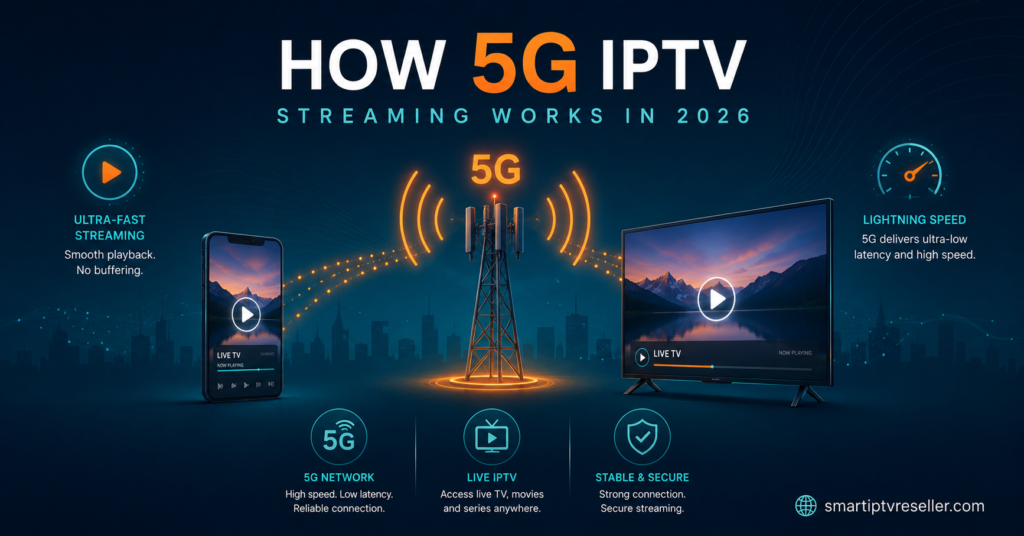
Here is the part people get wrong. They see “5G” on their phone and assume gigabit speeds everywhere. Reality is more grounded. In 2026, a good mid-band 5G connection in a covered town typically gives you download speeds that comfortably exceed what a single HD or 4K stream needs. A standard HD stream needs a few megabits per second. A 4K stream needs more, but still sits well inside what a healthy 5G signal provides.
The catch is consistency. Your speed dips when you move out of strong coverage, when the network is congested at peak times, or when you’re indoors behind thick walls. A stream doesn’t care about your average speed across the day. It cares about the speed in the exact second it needs the next chunk of video. That’s why a connection that “tests fast” can still hiccup.
So the honest rule for 5G IPTV Streaming 2026 is this: it’s not about hitting a huge number. It’s about holding a steady, sufficient number without sudden drops. A stable 30 to 50 Mbps that never wobbles beats a flashy 300 Mbps that collapses every few minutes.
| Stream Quality | Rough Speed Needed | 5G in 2026 |
|---|---|---|
| SD | 3 to 5 Mbps | Easy, even on weak signal |
| HD | 5 to 10 Mbps | Comfortable on most coverage |
| 4K UHD | 25 Mbps and up | Fine on strong mid-band 5G |
Pro Tip: Before promising a customer 4K on mobile, ask them to run a speed test at the spot where they’ll watch most, at the time they’ll watch most. Evening numbers in their living room tell you far more than a midday test outdoors.
Why Latency Matters for 5G IPTV Streaming 2026
Speed gets all the attention, but latency is the quieter half of the story. Latency is the delay between asking for data and receiving it, measured in milliseconds. Think of speed as how wide the pipe is and latency as how quickly the water starts flowing once you turn the tap.
For watching a film, a little latency barely matters because the player buffers ahead. For anything live, it matters a lot. High latency is what makes a live event feel behind, or what causes that annoying gap where the stream pauses to catch up. One of the genuine wins of 5G IPTV Streaming 2026 is that 5G latency is markedly lower than older mobile networks, often low enough that live content feels responsive rather than laggy.
But latency, like speed, swings with conditions. A congested cell tower at peak time adds delay. Distance from the mast adds delay. So the same advice holds: a good average isn’t enough, you want low latency that stays low. When you’re helping a customer troubleshoot a choppy live stream, latency spikes are often the real culprit, not raw speed. A short guide on stream stability from a trusted smart IPTV service can save you a lot of back-and-forth support messages.
Mobile Reselling and 5G IPTV Streaming 2026
This is where the opportunity sharpens for anyone running a panel. Traditionally, IPTV reselling leaned on customers with fixed home broadband. 5G IPTV Streaming 2026 widens that pool considerably. You can now confidently serve people who stream mainly on phones and tablets, people in flats with poor wired options, and people who travel for work and want their TV to travel with them.
The selling point writes itself. “Watch on the move, no home broadband required” is a real benefit you couldn’t honestly promise a few years ago. To deliver on it, though, your underlying service has to be built for mobile networks, not just home fibre. That means adaptive streaming that scales quality down smoothly when the signal dips, rather than freezing outright.
Pricing-wise, mobile customers often want shorter trial periods to test their own coverage first. Offering a short trial lets them prove it works on their network before committing. When you set up packages, it helps to think about how to manage credits and durations cleanly, and a well-organised approach to your reseller pricing keeps the mobile side simple to run alongside everything else.
Pro Tip: Make a one-line coverage checklist part of your onboarding. Ask new mobile customers two things: do they have steady 5G or strong 4G where they watch, and roughly what speed do they get there. It filters out the people who’ll only ever be frustrated, and it makes your support load far lighter.
Devices and Setups for 5G IPTV Streaming 2026
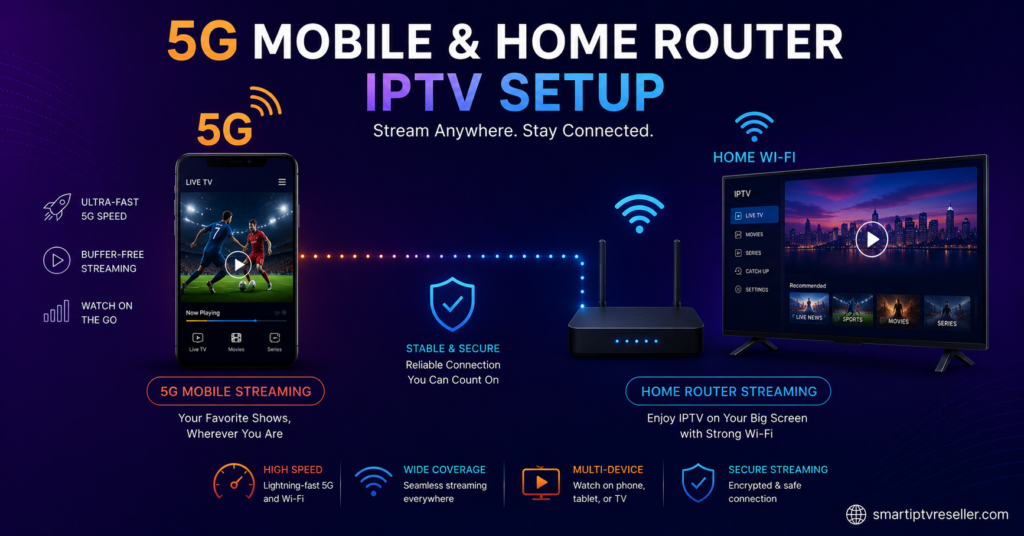
You don’t need exotic kit to make this work. The most common setup is the simplest: an IPTV player app on a phone or tablet, pulling the stream over 5G directly. It’s the purest form of mobile viewing and the one most of your travelling customers will use.
The second setup is more interesting for home use. A 5G home router takes the mobile signal and turns it into regular Wi-Fi for the whole house. This is genuinely useful for people who can’t get good wired broadband but sit in a strong 5G area. They plug in a router, connect a Firestick or a smart TV, and stream as if they had fibre. For some rural or hard-to-wire homes, this is the difference between having a usable service and having nothing.
Either way, the device matters less than the signal and the app. A cheap Android box on a strong 5G router will outperform an expensive setup on a weak signal every time. When advising customers, steer the conversation toward signal quality first and hardware second.
The Honest Limits of 5G IPTV Streaming 2026
It would be easy to oversell this, so here’s the straight talk. 5G IPTV Streaming 2026 is excellent where coverage is strong and consistent, and it’s frustrating where it isn’t. Coverage maps look impressive, but real-world signal varies street by street and even room by room. Indoors, behind brick or in a basement, 5G can drop to 4G or weaker without warning.
Data allowances are the other practical limit. Streaming for hours eats data fast. A customer on a small monthly data cap can burn through it in a few evenings of viewing. For heavy watchers, an unlimited or very large mobile data plan is close to essential, and that’s worth flagging before they sign up disappointed.
There’s also a legal grey area worth naming plainly. IPTV as a technology is completely legitimate, and plenty of lawful services use it. What matters is the content being streamed and whether it’s properly licensed. As a reseller, the responsible path is to operate within broadcasting rules, point customers toward official broadcasters for licensed live programming, and keep your business on the right side of the line. Glossing over this helps nobody.
Pro Tip: When a mobile customer reports buffering, check three things in order before blaming the service: their current signal strength, their remaining data allowance, and whether they’re indoors. Nine times out of ten, the answer is sitting in that list.
How 5G IPTV Streaming 2026 Compares to Home Broadband
People often ask whether they should drop their fixed broadband entirely and go all-in on 5G. The honest answer is “it depends, and probably not yet for most.” Where the two genuinely differ is predictability. Wired broadband, especially fibre, tends to deliver the same speed and latency hour after hour. 5G is more variable by nature because it’s a shared mobile signal affected by location, weather, and crowd size.
That said, for the right person, 5G IPTV Streaming 2026 is a legitimate primary connection. Someone in a strong coverage area with an unlimited data plan can run their whole household TV through a 5G router and barely notice a difference. Someone in a patchy area is better treating it as a flexible second option for watching on the go.
| Factor | Fixed Broadband | 5G in 2026 |
|---|---|---|
| Consistency | Very steady | Varies with signal |
| Mobility | None, fixed to home | Watch anywhere with coverage |
| Setup | Engineer or line needed | Plug-in router or just an app |
For a reseller, the takeaway is to match the pitch to the person. Sell 5G as freedom and flexibility, not as a guaranteed fibre replacement, and your customers stay happy because you set the expectation correctly from the start.
Conclusion
5G IPTV Streaming 2026 has crossed the line from “interesting idea” to “genuinely usable,” and that’s the real shift this year. The speeds are there for HD and even 4K on a strong signal, the latency is low enough for live content to feel responsive, and mobile reselling has become a proper avenue rather than a niche. The whole thing rests on two simple truths: a steady connection beats a fast-but-flaky one, and honest expectations keep customers happy. Sell it as flexibility and freedom, be upfront about coverage and data limits, and 5G IPTV Streaming 2026 becomes a strong addition to any UK IPTV reseller’s offer rather than a source of support headaches. Get those basics right and you’re not just keeping pace with where streaming is heading, you’re already there.
Surprise Section: Your 5G IPTV Streaming 2026 Checklists
Subscriber Checklist
Run a speed test where and when you’ll actually watch most, not just outdoors at midday.
Confirm you have strong 5G or solid 4G in that exact spot, including indoors.
Check your monthly data allowance, and go unlimited if you stream for hours.
Use a proper IPTV player app and start a short trial before committing.
For a whole-home setup, get a 5G router if your wired broadband is poor but your signal is strong.
Reseller Checklist
Make sure your service uses adaptive streaming that scales quality down smoothly on weak signal.
Offer a short trial so mobile customers can test their own coverage first.
Add a two-question coverage check to onboarding: signal quality and rough speed.
Set clear expectations: sell 5G as flexible, not as a guaranteed fibre replacement.
Keep a simple troubleshooting order ready: signal, data allowance, indoor or outdoor.
Sub-Reseller Checklist
Learn the basics of speed versus latency so you can answer customer questions confidently.
Push the “watch on the move” benefit, since it’s the strongest mobile selling point.
Always flag data caps to customers before they buy, to avoid disappointment.
Keep your packages and credit durations organised so the mobile side stays easy to run.
Operate responsibly, point customers to official broadcasters for licensed live content, and stay within the rules.