Smart IPTV Alternative Apps: What Resellers Are Actually Deploying in 2026
A subscriber rings you at 9:47 PM during a Champions League knockout. Their Smart IPTV app has wiped its playlist for the third time this month. You both know what’s coming next — a refund request, a one-star review, maybe a churned account that was paying you £80 a year. This single failure cycle is why thousands of operators have spent the last eighteen months quietly migrating their entire customer base to Smart IPTV Alternative Apps that don’t behave like ticking time bombs.
The honest reality is that “Smart IPTV” as a brand carried far more weight than it deserved by 2024. It worked, it was familiar, and IPTV resellers used it because subscribers already knew the name. That goodwill is gone now. The app that defined an entire era of household streaming has been overtaken by a generation of Smart IPTV Alternative Apps that handle codecs better, survive ISP-level interference, and crucially, don’t disappear from app stores overnight.
This isn’t a list pretending everything is equally good. It’s a working operator’s breakdown of what’s actually deployable in 2026, what fails in the field, and how to migrate without losing half your panel credits to refund disputes.
Why The Old Default Stopped Being The Default
For nearly a decade, Smart IPTV held a near-monopoly on Samsung Tizen and LG webOS households. It was the path of least resistance. Resellers would just paste a M3U URL into the device portal, attach the MAC address, and walk away. That model fractured.
Three things broke simultaneously: the app’s licensing model shifted, regional removals accelerated, and ISP-level DNS poisoning began targeting the specific endpoints Smart IPTV relied on for playlist syncing. When that combination hit, even well-funded operators saw 30–40% of their Smart TV-based subscribers complaining within a single quarter. Smart IPTV Alternative Apps weren’t a luxury anymore. They became operational necessity.
Pro Tip: Never migrate an entire customer base to a single Smart IPTV alternative. Spread risk across at least three apps so a single takedown doesn’t collapse your support inbox overnight.
What separates serious operators in 2026 from struggling ones is having a tested toolkit of Smart IPTV Alternative Apps mapped to specific device types, customer skill levels, and load profiles. One app for the tech-comfortable customer, another for the grandparent setup, a third for the fire-stick household. Generic recommendations don’t survive contact with reality.
The Replacement Landscape, Sorted By Actual Use Case
Before naming names, understand the categorisation that experienced resellers use internally. Smart IPTV Alternative Apps fall into roughly four buckets, and confusing them is the fastest way to deploy the wrong tool for the wrong customer.
- Smart TV-native apps: Run directly on Tizen, webOS, or VIDAA without external hardware
- Sideloaded Android-based players: Require an Android TV box, Fire TV, or Nvidia Shield
- Cross-platform clients: Work on phones, tablets, and desktop alongside TVs
- Hybrid panel apps: Custom-branded clients tied directly to a reseller’s own infrastructure
The mistake most newer resellers make is treating all Smart IPTV Alternative Apps as interchangeable. They aren’t. A subscriber on a five-year-old Samsung needs something fundamentally different from a household running a 4K Nvidia Shield, and pretending otherwise leads to support tickets you’ll spend three hours resolving for a £6/month account.
IBO Player, Set IPTV And The Smart TV Continuity Camp
When subscribers want a near-identical experience to what they had before, IBO Player Pro and Set IPTV are the two Smart IPTV Alternative Apps most operators reach for first. Both run natively on Samsung and LG, both accept M3U and Xtream Codes inputs, and both have survived multiple takedown waves because their developers maintain redundant distribution channels.
IBO Player Pro deserves particular attention. Its EPG handling is noticeably more forgiving than the original Smart IPTV ever was, especially when your provider’s XMLTV feed is slightly malformed. It also handles re-buffering more gracefully — instead of crashing the playlist, it attempts segment retry, which makes a real difference during HLS latency spikes from upstream providers.
Set IPTV is the more conservative choice. Its interface mimics the original almost intentionally, which matters when migrating older subscribers who panic at any UI change. The trade-off is that Set IPTV’s playlist refresh logic is slower, and its EPG window is narrower.
Pro Tip: When migrating an existing household, screenshot their Smart IPTV layout before uninstalling. You’ll halve your “but it doesn’t look the same” support tickets if you can replicate their channel ordering manually.
For resellers managing 200+ MAC addresses, both apps offer reseller backend portals where you can manage activations in bulk. That alone makes them serious contenders among Smart IPTV Alternative Apps targeting the smart-TV-only segment.
The Android Sideload Camp: Where Power Users Live
If your subscriber owns any Android-based streaming device, the alternative landscape opens up enormously. This is the segment where Smart IPTV Alternative Apps reach genuinely professional quality, because Android’s open ecosystem allowed developers to iterate without store gatekeeping.
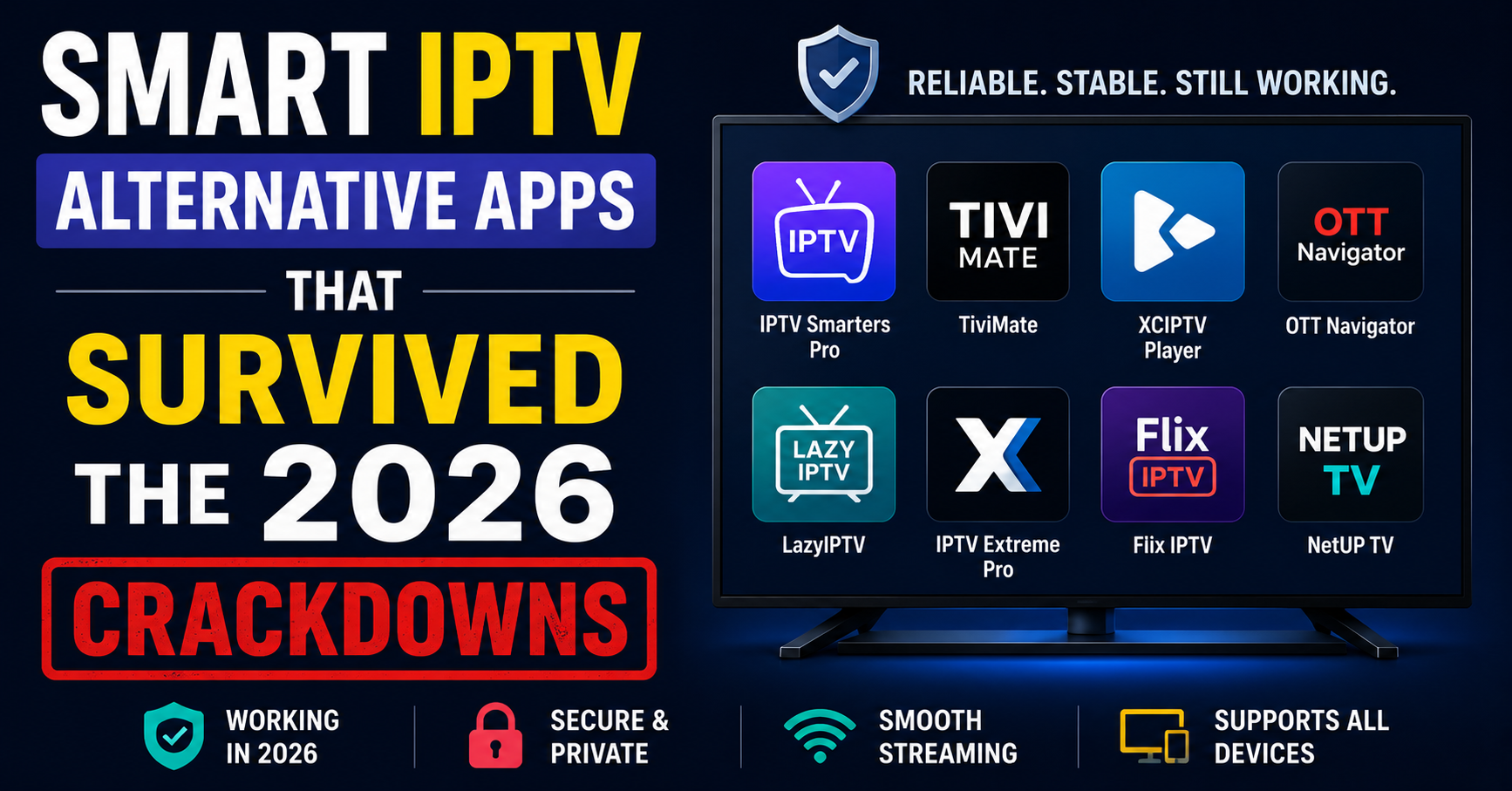
The serious contenders here are TiviMate, IPTV Smarters Pro, OTT Navigator, and Sparkle TV. Each has a distinct personality:
- TiviMate: Premium tier UX, best EPG handling in the category, but requires a paid subscription for full features
- IPTV Smarters Pro: The reseller workhorse — heavily white-labellable, broad codec support, decent load balancing
- OTT Navigator: Excellent for power users who want catch-up TV, archive playback, and granular settings
- Sparkle TV: Lightweight, fast launch times, ideal for older Fire Stick generations
Among these, IPTV Smarters Pro remains the dominant deployment choice for resellers wanting to brand the experience as their own. The white-label version lets you embed your own logo, support links, and panel credentials directly, which dramatically reduces the cognitive load on subscribers who never need to see a generic “Smart IPTV Alternative Apps” recommendation list.
The Comparison Table Most Resellers Need
Specifications matter less than field behaviour. Here’s how the leading Smart IPTV Alternative Apps actually compare across the dimensions that affect your support load.
| App | Best Device Class | EPG Quality | Buffer Recovery | Reseller Branding | Risk of Takedown |
|---|---|---|---|---|---|
| IBO Player Pro | Samsung/LG TVs | High | Strong | Limited | Low |
| Set IPTV | Samsung/LG TVs | Medium | Medium | None | Low |
| TiviMate | Android TV/Shield | Excellent | Strong | None | Medium |
| IPTV Smarters Pro | Android/Fire TV | High | Strong | Full white-label | Medium |
| OTT Navigator | Android TV | Excellent | Excellent | None | Medium |
| Sparkle TV | Older Fire Sticks | Medium | Medium | Limited | Low |
| XCIPTV Player | Android/Fire TV | High | Strong | Full white-label | Low |
The takedown risk column matters more than people admit. Apps with reseller branding capability tend to attract more scrutiny because they’re tied to commercial distribution patterns. Spreading your customer base across both branded and unbranded Smart IPTV Alternative Apps insulates you from a single vendor disappearing.
What ISP Blocking Trends Are Doing To App Selection In 2026
Something fundamental shifted in late 2025. Several major ISPs across the UK, Italy, and Spain deployed AI-assisted traffic classification systems that don’t just block known IPTV domains — they identify the behavioural signature of streaming traffic and throttle it dynamically. This changed how operators evaluate Smart IPTV Alternative Apps.
The apps that survive this environment best are the ones that handle adaptive bitrate intelligently. When an ISP starts shaping a connection mid-stream, weaker apps will buffer forever or simply error out. Stronger players will downshift quality, reconnect to a backup uplink server, and recover within seconds.
Pro Tip: Test every Smart IPTV alternative on a connection that’s actively being throttled before approving it for customer rollout. Run a one-week trial on a UK residential line during peak hours — the apps that survive that test are the only ones you should deploy at scale.
Backup uplink servers are no longer optional infrastructure. Whichever Smart IPTV Alternative Apps you recommend, they must support failover to secondary endpoints, ideally through a load-balanced reverse proxy you control. Resellers who skip this layer are watching their customer satisfaction collapse during prime-time peaks.
The Migration Playbook Nobody Publishes
Moving subscribers from Smart IPTV to a replacement isn’t a single decision — it’s a sequence. The order matters enormously, and getting it wrong costs you panel credits and renewal income.
Here’s the sequence that has worked across thousands of household migrations:
- Audit the device first. Don’t ask “what app do you want?” Ask what TV brand, year, and any external streaming devices they own.
- Match to one of two or three pre-approved Smart IPTV Alternative Apps, not the entire catalogue. Choice paralyses non-technical subscribers.
- Pre-configure where possible. For Android-based devices, send a downloadable config link rather than walking them through manual M3U entry.
- Run the old and new app in parallel for 48 hours. Don’t kill the Smart IPTV setup until the replacement has survived two evenings of actual viewing.
- Schedule a check-in on day seven. Most failures surface within the first week, and proactive contact reduces refund requests by roughly 60%.
This sequence treats migration as a structured operation rather than a customer service reaction. The resellers who follow it retain customers through the transition. The ones who don’t lose churn-vulnerable accounts to competitors offering smoother onboarding.
Why Custom Branded Apps Are Quietly Winning
The most interesting trend among professional operators is the slow shift away from generic Smart IPTV Alternative Apps entirely. Custom-branded panel apps — built on frameworks like IPTV Smarters or XCIPTV but heavily white-labelled — are becoming the long-term play.
The advantages are structural. A branded app sits in your subscriber’s app drawer with your logo on it. They don’t see app store names, don’t search for alternatives when something glitches, and don’t accidentally find a competitor’s promotional video while looking for setup help. The relationship becomes single-vendor.
The cost is initial setup. You need an Apple developer account or Android signing infrastructure, you need to manage updates, and you need to handle the legal positioning of distribution. But for any reseller running 500+ active subscribers, the math favours owning the front-end experience rather than relying on third-party Smart IPTV Alternative Apps that could vanish in a takedown wave.
Pro Tip: If you’re not ready to build a fully custom app, deploy IPTV Smarters Pro’s white-label option as a stepping stone. It costs a fraction of a custom build and lets you test whether subscribers respond to a branded experience before committing serious capital.
This shift is also why panel credits and load balancing infrastructure are increasingly bundled with custom app deployments. The whole stack — panel, server cluster, branded app — gets sold as a single proposition rather than fragmented across vendors.
Common Failure Patterns Nobody Warns You About
Plenty gets written about which Smart IPTV Alternative Apps are good. Almost nothing gets written about how they fail. Here’s what actually breaks in production.
EPG drift is the silent killer. Several alternatives will display channel guides for the wrong timezone if the device’s regional settings don’t match the EPG source. Subscribers will see “wrong programmes” and assume the service is broken, when it’s actually a configuration issue you can solve in thirty seconds — if you know to look.
DNS poisoning at the home router level affects different apps differently. Some Smart IPTV Alternative Apps resolve domains internally using hardcoded DNS, which bypasses ISP-level interference. Others use the system resolver and fail silently when an ISP starts redirecting requests. This is why two subscribers on the same ISP can have wildly different experiences with the same app.
Codec support gaps catch out resellers offering premium sports streams. Some channels deliver content in HEVC at high bitrates, and not every alternative handles that gracefully on older hardware. Test your premium tier specifically on each app before recommending it.
Frequently Asked Questions
What are the best Smart IPTV Alternative Apps for Samsung TVs in 2026?
For Samsung Tizen households, IBO Player Pro and Set IPTV remain the most reliable Smart IPTV Alternative Apps available natively on the platform. IBO Player Pro has stronger EPG handling and better buffer recovery, while Set IPTV offers a more familiar interface for subscribers migrating directly from the original Smart IPTV experience. Both support M3U and Xtream Codes inputs.
Why did Smart IPTV stop working reliably for many subscribers?
Smart IPTV faced a combination of licensing changes, regional app store removals, and ISP-level DNS interference that targeted its playlist sync endpoints. These pressures compounded between 2023 and 2025, making the app unreliable for households that previously had no issues. Most resellers responded by migrating customers to more resilient Smart IPTV Alternative Apps with better failover infrastructure.
Can I use the same M3U link across different Smart IPTV Alternative Apps?
Yes, in almost all cases. A standard M3U or Xtream Codes credential set will work across IBO Player Pro, Set IPTV, IPTV Smarters Pro, TiviMate, OTT Navigator, and XCIPTV Player without modification. The only adjustments needed are app-specific settings like EPG source URLs, which sometimes require minor reformatting depending on the player.
How do I migrate subscribers without losing them to refund requests?
Run the old and new app in parallel for at least 48 hours before disabling the original setup. Pre-configure the replacement where possible, document any UI differences in advance, and follow up with subscribers within seven days. Most migration failures happen in the first week, and proactive contact reduces refund requests dramatically.
Is it legal to use Smart IPTV Alternative Apps?
The apps themselves are legitimate software tools — their legality depends entirely on the content you stream through them. Many subscribers use these players for personal media libraries, public domain content, or properly licensed services. Resellers should always verify that their content provider holds the appropriate distribution rights for the regions being served.
What makes a Smart IPTV alternative app reseller-friendly?
Reseller-friendly apps offer white-label branding, bulk activation management, and developer portals for customer support. IPTV Smarters Pro and XCIPTV Player lead the category because both allow full visual rebranding, custom support links, and embedded panel credentials. This lets operators present a unified brand experience rather than directing customers to generic third-party apps.
How do Smart IPTV Alternative Apps handle ISP throttling?
Stronger alternatives implement adaptive bitrate streaming, automatic failover to backup uplink servers, and intelligent segment retry logic. When an ISP begins shaping traffic mid-stream, well-built apps will downshift quality and reconnect within seconds. Weaker apps simply error out or buffer indefinitely. Always test alternatives on actively throttled connections before deploying them to your subscriber base.
Do I need a separate device to run these apps?
Not always. IBO Player Pro and Set IPTV install directly onto Samsung and LG smart TVs without extra hardware. However, Android-based Smart IPTV Alternative Apps like TiviMate, IPTV Smarters Pro, and OTT Navigator require an Android TV box, Fire TV stick, or Nvidia Shield. For older TVs without app store access, a small streaming device is typically the most reliable solution.
Reseller Success Checklist
Before you migrate a single subscriber, work through this list. Skip steps at your own risk.
- Audit your current subscriber base by device type before recommending any Smart IPTV Alternative Apps — a one-size-fits-all migration creates avoidable support tickets
- Shortlist no more than three replacement apps for your customer base so you can master support for each one rather than spreading thin across seven
- Test every shortlisted app on a throttled residential connection during peak evening hours to confirm real-world performance
- Build a pre-configured installation guide for each device class — Samsung Tizen, LG webOS, Fire TV, Android TV — so customers receive specific instructions rather than generic walkthroughs
- Maintain backup uplink servers behind a load-balanced reverse proxy so subscribers experience seamless failover when primary endpoints face DNS poisoning or blocking
- Run new and old apps in parallel for 48 hours during every migration to catch playlist or EPG issues before refund requests start
- Schedule a seven-day follow-up with every migrated subscriber — proactive contact slashes churn in the first month
- Consider white-labelled or fully custom-branded Smart IPTV Alternative Apps if you operate 500+ active accounts, because owning the front-end experience pays for itself in retention
- Verify codec compatibility for premium sports streams on each app and each device class, because HEVC handling varies wildly between players on older hardware
- Document your shortlist publicly on your reseller storefront so prospective customers can self-select the right setup — see how British Seller’s reseller infrastructure handles app recommendations as part of the onboarding flow
- Track refund reasons by app so you can spot patterns early — if one Smart IPTV alternative produces a disproportionate number of complaints, kill it from your recommended list before it damages your reputation
- Build a one-page internal cheat sheet mapping each Smart IPTV alternative to its known weaknesses and quick fixes, so your support team resolves tickets in minutes instead of hours
The operators thriving in 2026 aren’t the ones who picked the single “best” app. They’re the ones who built a structured deployment framework around a curated set of Smart IPTV Alternative Apps and treated migration as an operational discipline. That’s the difference between a reseller business that scales and one that constantly fights fires.