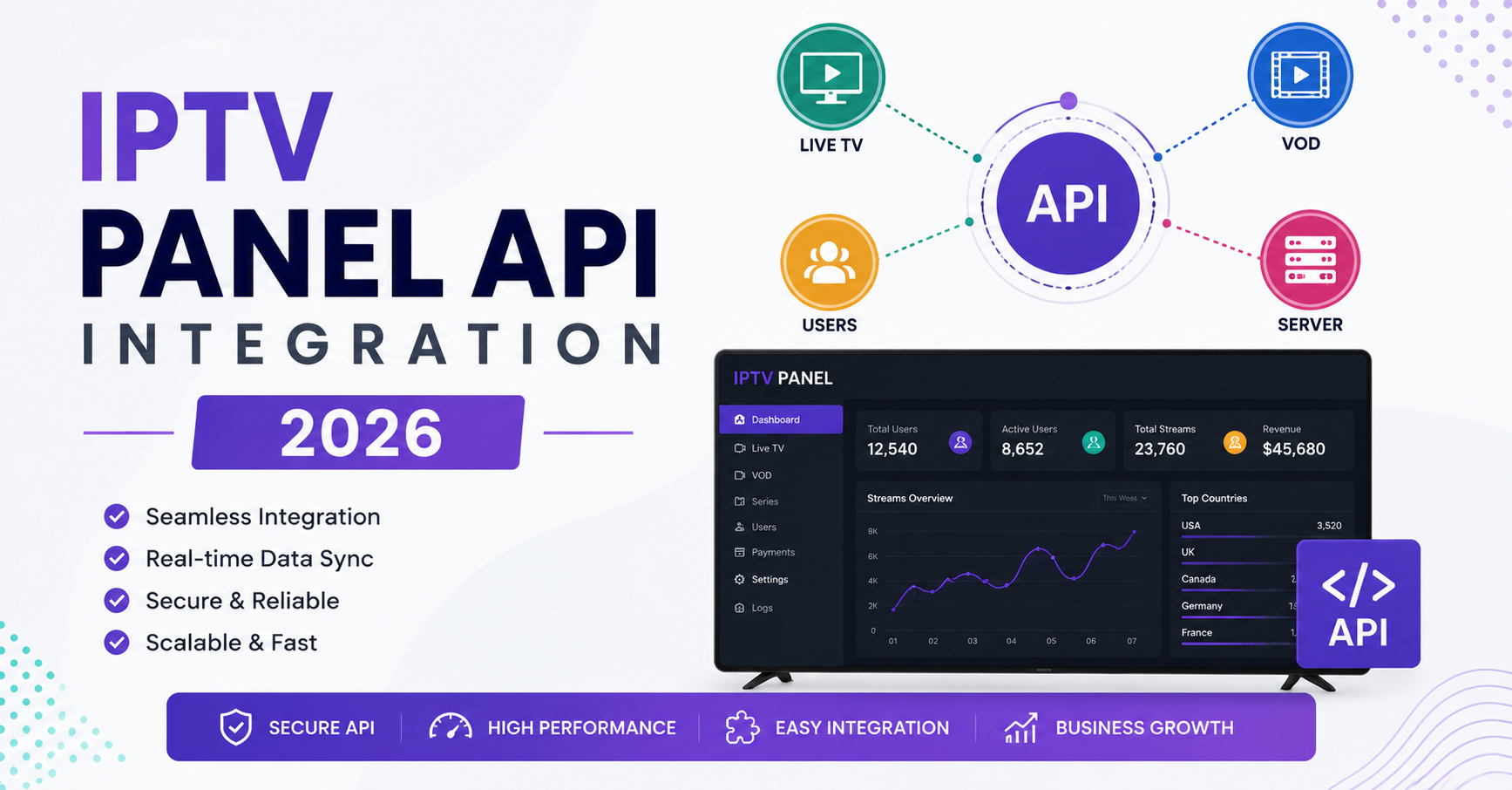
IPTV Panel API Integration 2026: Automate Your Business
Most resellers who approach IPTV panel API integration for the first time expect a clean plug-and-play experience. They read a few forum threads, find an endpoint list, and assume the hard part is just formatting a JSON request. Two weeks later, they are dealing with rate limit errors, broken subscription sync, and customers whose accounts never activated. IPTV panel API integration in 2026 is genuinely useful, but it punishes anyone who skips the operational groundwork.
The short answer: if you are an IPTV reseller managing more than 50 active subscriptions, API integration is not optional anymore. Manual panel management at scale creates delays, errors, and support load that will steadily erode your customer retention. Done correctly, IPTV panel API integration removes the human bottleneck from your provisioning workflow entirely.
Why Manual Panel Management Breaks at Scale
Here is what actually happens. A IPTV reseller panel running 80 to 150 active connections can be managed manually with some discipline. You create accounts, assign credits, extend expiry dates, handle the occasional cancellation. It is tedious but functional. Push past 200 active subscriptions and the cracks appear fast.
Renewal windows get missed. Customers email asking why their subscription expired when they paid three days ago. A sub-reseller contacts you at midnight because they sold a trial and cannot provision it themselves. Meanwhile you are logged into the panel clicking through pages trying to stay on top of it.
The operational bottleneck in most IPTV reseller businesses is not infrastructure. It is provisioning speed. API integration solves exactly that.
What IPTV Panel API Integration Actually Does
The API layer sits between your reseller panel and any external system you want to connect, whether that is a payment processor, a customer management dashboard, a Telegram bot, or a custom storefront. When a payment is confirmed, the API call creates the subscription automatically. When the expiry window approaches, the API call sends a renewal prompt. When a customer cancels, the API call deactivates the account without you touching the panel.
In practical terms, IPTV panel API integration in 2026 gives the IPTV operator the ability to run an almost touchless provisioning operation.
Pro Tip:
Before writing a single line of API code, map your existing provisioning workflow on paper. Every manual step you currently do in the panel becomes an API call you need to plan. Resellers who skip this mapping phase build incomplete integrations and end up with hybrid manual-plus-API workflows that are harder to manage than either approach alone.
The Endpoints That Actually Matter
Most IPTV reseller panels built on Xtream-Codes-style architecture expose a fairly consistent API surface, though implementations vary. The endpoints that carry the most operational weight are the ones controlling line creation, expiry extension, package assignment, and connection status checks.
Here is what experienced IPTV operators actually spend their API integration time on:
Line creation: POST request with username, password, package ID, expiry timestamp, and optionally a bouquet or output format assignment. The response should return a line ID and activation status.
Expiry management: GET request by line ID returning current expiry, connection status, active streams, and last connection timestamp. PATCH or PUT to extend expiry on renewal.
Credit balance check: GET request returning current panel credits available to the reseller. This is critical for automated provisioning because your bot will try to create lines regardless of whether you have credits remaining.
Trial conversion: creating a trial line, monitoring its activity status via API, then converting it to a paid subscription or auto-expiring it.
Package and bouquet assignment: listing available packages and assigning them at line creation or modification. Resellers who offer multiple content tiers depend on this.
Errors That Show Up in Real Deployments
After reviewing integration setups across multiple reseller businesses, a handful of failure patterns appear consistently.
The most common is credit balance blindness. The reseller automated provisioning but did not build a credit check before each line creation call. When credits run out, the API returns an error, the payment was already confirmed, and the customer account never activated. The customer raises a dispute. The IPTV reseller spends an hour investigating something a three-line credit check would have prevented.
The second recurring issue is expiry timezone mismatch. The panel stores expiry in UTC. The reseller’s payment system timestamps in local time. Over weeks, subscriptions start expiring several hours before customers expect, generating a wave of support tickets every renewal cycle.
| Common API Integration Mistake | What Actually Happens | Fix |
|---|---|---|
| No credit balance check before provisioning | Payment confirmed, account never created | Add pre-provisioning credit check call |
| Timezone mismatch on expiry timestamps | Subscriptions expire hours early | Normalize all timestamps to UTC |
| No webhook for failed API calls | Silent failures, customers get no account | Add error logging and retry queue |
| Missing rate limit handling | Burst requests get blocked by panel | Add request queuing with delay |
| No status monitoring on created lines | Cannot detect inactive accounts | Schedule daily connection status checks |
Rate Limits Are Not Optional Reading
One thing resellers discover the hard way: IPTV panel API endpoints are not built for high-frequency concurrent requests. Most panel deployments running on shared or budget infrastructure impose either soft rate limits through server-side throttling or hard limits at the reverse proxy layer.
During one reseller migration project where a business was shifting around 300 active lines to a new panel, the provisioning script sent batch creation requests without any delay. The panel treated it as an attack pattern, the IP got temporarily blocked by the firewall, and the migration stalled for four hours while the IPTV operator contacted the upstream provider to whitelist the automation IP.
The practical fix is straightforward but most documentation does not mention it explicitly: queue your API requests. Send one creation request, wait 800ms to 1.2 seconds, send the next. During batch operations, never exceed 40 to 50 requests per minute unless the panel provider has explicitly confirmed higher throughput limits.
Pro Tip:
Ask your panel provider directly what the API rate limit is before building your integration. If they cannot give you a number, assume 30 requests per minute as a safe ceiling and build your queue logic around that. It is far easier to increase throughput later than to debug a blocked IP at 2am during an onboarding batch.
Building a Reseller Panel Integration That Actually Holds Up
The architecture that works in production for a mid-size IPTV reseller business looks like this. A payment processor webhook fires on successful payment. The webhook handler validates the payload, checks available panel credits via API, creates the line, stores the line ID and credentials against the customer record, and sends the customer their access details. All of this happens without the panel owner touching anything.
For sub-resellers, the same logic applies but with an additional layer. The sub-reseller storefront triggers the call to the parent reseller’s API integration layer, which handles the panel call and returns the credentials. The IPTV operator in the middle manages credit distribution without manually provisioning each sub-reseller’s sales.
IPTV resellers scaling past 500 active lines typically add a separate monitoring job running every four to six hours that checks connection status on all active lines, flags accounts that have not connected in 10 or more days, and sends automated re-engagement messages. This alone significantly improves renewal rates because it surfaces churning customers before they actually cancel.
Pro Tip:
Build your integration so that every API call result, including errors, writes to a log before anything else happens. When something breaks at midnight on a Friday, that log is the only thing standing between you and hours of blind investigation.
What Modern ISP Interference Means for API-Dependent Operations
This is where 2026 is genuinely different from earlier years. AI-driven traffic analysis tools deployed by ISPs in several markets can now identify IPTV streaming traffic based on packet timing patterns rather than port numbers or destination IPs. What this means operationally is that stream delivery disruptions happen with less warning and less predictability than they did.
For an IPTV operator running an API-integrated provisioning system, this creates a specific problem. Customers get provisioned correctly and immediately, but then experience stream interruptions unrelated to provisioning. They raise support tickets. The panel owner checks the API, sees the line is active and properly provisioned, and cannot immediately identify that the disruption is ISP-level.
Building a connection quality check into your monitoring layer helps here. If a high percentage of active lines in a geographic cluster are showing repeated reconnection attempts, that is a signal of ISP interference rather than a provisioning or panel issue. The IPTV reseller who catches this pattern early and communicates it proactively to customers handles it far better than the one who waits for support tickets to pile up.
How Sub-Resellers Should Use API Access
Most panel owners give sub-resellers either direct panel login or a limited credits allocation without API access. This is an operational mistake that creates a provisioning bottleneck every time a sub-reseller makes a sale.
Giving sub-resellers read-only or restricted API access to check their own credit balance, view their active lines, and provision their own customers changes the dynamic entirely. The IPTV business owner stops being the provisioning bottleneck for their distribution network.
The risk is misuse. A sub-reseller with API access who overprovisioned against their credit allocation can cause provisioning failures for other sub-resellers sharing the same credit pool. The fix is a per-sub-reseller credit ceiling enforced at the API integration layer before any panel call is made. This is standard practice for IPTV operators running multi-tier distribution networks.
Panel API Integration Options in 2026
| Integration Approach | Best For | Main Risk |
|---|---|---|
| Direct API scripting | Technical resellers building custom tools | Maintenance burden when panel updates |
| Telegram bot integration | Small to mid-size reseller panel owners | Limited error handling in most bot frameworks |
| WooCommerce plus API plugin | Resellers with WordPress storefronts | Plugin dependency and update conflicts |
| Custom dashboard with API backend | Large-scale IPTV operators and credit resellers | Higher upfront development cost |
| Third-party automation platforms | Non-technical resellers needing quick setup | Platform fees and limited customisation |
For resellers in the UK market looking for a panel infrastructure that supports clean API workflows, britishseller.co.uk offers panel access with documentation that covers the provisioning endpoints most resellers need day one.
FAQ
What is IPTV panel API integration in 2026?
IPTV panel API integration in 2026 refers to connecting your reseller panel to external systems, like payment processors or customer dashboards, so that provisioning, renewals, and account management happen automatically. For any IPTV reseller managing more than a few dozen active subscriptions, this is the foundation of a scalable business operation.
How does IPTV panel API integration affect my reseller business?
It removes the manual provisioning step from every sale. When IPTV panel API integration is working correctly, a payment confirmation triggers the account creation, sends credentials to the customer, and updates your records without any manual input. It also enables real-time monitoring of active lines and automated renewal reminders.
What credentials do I need to start using the API on my reseller panel?
Most IPTV reseller panels require an API key or a username-password pair with API-level access permissions. You will typically also need the panel’s base URL and the endpoint structure. Request this directly from your upstream provider because some panels require API access to be explicitly enabled on your account.
Can sub-resellers access the panel API?
Yes, but only if the IPTV operator configures it that way. Giving sub-resellers restricted API access to check credits and provision their own customers reduces the support load on the panel owner significantly. Always enforce a credit ceiling per sub-reseller at the integration layer to prevent over-provisioning.
What happens if the API call fails during provisioning?
If no error handling exists, the customer payment succeeds but no account is created. They never receive credentials. This is one of the most damaging failure modes in an IPTV reseller business because it combines a customer complaint with a disputed payment. Always build a retry queue and logging system into your API integration before going live.
How often should I poll the panel API for line status?
For monitoring purposes, every four to six hours is sufficient for most IPTV operators. Polling more frequently than once every 15 minutes for active line checks on large subscriber bases risks triggering rate limits. For event-driven checks, like verifying a line immediately after provisioning, a single check 30 to 60 seconds post-creation is adequate.
Does IPTV panel API integration protect against ISP blocking?
No. API integration manages provisioning workflows, not stream delivery. ISP blocking operates at the network layer and affects content delivery regardless of how cleanly your provisioning automation runs. These are separate concerns that require separate infrastructure responses.
What is the biggest mistake resellers make with API integration?
Not building credit balance checks into the provisioning flow. An IPTV reseller who automates provisioning without checking available panel credits first will eventually confirm a payment, attempt a line creation, fail silently, and face a customer dispute they cannot explain. It is a five-minute fix to add the check and a multi-hour problem when it is missing.
Action Checklists
For IPTV Subscribers
Confirm your activation email arrives within 5 minutes of payment. If not, contact your reseller immediately rather than waiting.
Check that your credentials work in your IPTV player before assuming the issue is with the content or channel.
If your subscription expires before the stated end date, ask your reseller for the exact expiry timestamp from the panel. Timezone errors are common and provable.
Save your M3U URL or Xtream login details somewhere accessible. Resellers using automated systems cannot always reissue credentials instantly.
For IPTV Resellers
Audit your provisioning workflow before building any API integration. Every manual step maps to an API call you need to plan.
Add a credit balance check as the first call in every provisioning sequence. Do not skip this.
Build error logging into your integration before going live. Silent failures are the most damaging failure type in an automated IPTV reseller operation.
Normalize all expiry timestamps to UTC at the point of entry. Fix timezone handling before you have 300 active subscriptions and not after.
Set up a recurring line status check job. Inactive accounts are churning customers you have not reached yet.
Test your full provisioning loop with a real payment before onboarding any customers to the automated system.
For Sub-Resellers
Request API access from your panel owner if you are provisioning more than 10 accounts per week manually.
Confirm your credit ceiling before running any promotional campaign. Running out of credits mid-campaign is a recoverable operational problem but only if you catch it in time.
Keep a local log of every line ID and customer mapping. If the panel goes offline, your log is the only record you have.
Never provision a line without confirming the credit deduction registered correctly. Check your credit balance before and after the first provisioning call to validate that the integration is functioning.
Closing Insight
IPTV panel API integration in 2026 is not a technical luxury for large operators. It is the operational threshold that separates UK IPTV resellers Panel who scale from those who stall. The provisioning workflow is where customer trust is either earned or lost in the first 5 minutes after a sale. Build that workflow correctly, log everything, and treat the credit balance check as non-negotiable. Everything else in this article is context. That single habit is the one that prevents the most expensive mistakes.