
The Stream That Killed a Saturday
It was a Premier League weekend. Forty-three subscribers. One UHD stream per connection. By 3:05 PM, sixteen of them had gone dark, not buffering, not pixelating, just gone. Black screen. The provider’s server had choked on simultaneous 4K HEVC pulls, the CDN failover had never been tested, and my support inbox turned into a war zone inside eight minutes.
That Saturday taught me more about UHD IPTV infrastructure than any forum thread ever could. Ultra-HD isn’t just a higher resolution, it’s a fundamentally different operational challenge, and the UK IPTV Panel reseller market in 2026 is still littered with people who haven’t figured that out yet.
UHD IPTV demands bandwidth headroom that most budget providers simply don’t engineer for. A single 4K HEVC stream sits comfortably between 15–25 Mbps. Multiply that across a growing subscriber base and you’re not running an IPTV panel, you’re running a small ISP. The infrastructure calculus changes entirely.
Why UHD IPTV Breaks Resellers Who Aren’t Ready
The failure mode is almost always the same. A reseller sources a cheap panel, notices the provider advertises “4K channels,” lists UHD IPTV as a selling point, and starts onboarding customers. Everything holds together at low volume. Then a big match weekend arrives.
What collapses first isn’t the panel, it’s the upstream. Budget providers oversell server capacity. They’ll run a 1Gbps uplink feeding three hundred concurrent UHD streams that mathematically require far more. The maths is unforgiving and non-negotiable.
Concurrent UHD Bandwidth Requirement:
Total Required Bandwidth (Mbps) = Number of Concurrent UHD Streams × Average Bitrate per Stream (Mbps)
For 200 subscribers at 20 Mbps average:
Total = 200 × 20 = 4,000 Mbps (4 Gbps minimum uplink requirement)
Any provider not running 10Gbps+ uplinks for a catalogue of live UHD IPTV channels is already overselling. Ask the question directly before you sign a reseller agreement, and if they dodge it, walk away.
Pro Tip: Request a stress test during a live sports window, not a Tuesday afternoon. Any provider can hold UHD streams when traffic is low. What matters is performance under Saturday peak load. If they won’t test it, they already know the result.
The HEVC Advantage, and Where It Quietly Breaks Down
HEVC (H.265) encoding is the standard backbone of any competent UHD IPTV operation in 2026. It delivers roughly half the bitrate of H.264 at equivalent quality, which sounds like the solution to every bandwidth problem. In practice, it introduces a different set of complications.
Device compatibility remains fragmented. MAG boxes below a certain firmware revision will struggle with HEVC decode. Older Android boxes throw frame drops on 4K HEVC under load. Clients using budget Firestick models without hardware HEVC acceleration will experience stuttering regardless of how clean your upstream is. You’re not just selling a stream, you’re selling a playback experience, and the weakest device in your customer’s setup defines that experience.
| Device category | HEVC 4K support | Recommended for UHD IPTV |
|---|---|---|
| Firestick 4K Max (2024+) | Full hardware decode | Yes |
| MAG 524W3 | Full support | Yes |
| Older MAG 410/420 | Partial, unreliable | No |
| Budget Android box (no cert) | Software decode only | Conditional |
| Apple TV 4K (Gen 3) | Full support | Yes |
Build a device compatibility FAQ into your onboarding. Customers who blame buffering on your service, when the real culprit is their 2019 Android box, will churn and leave negative sentiment behind them. Pre-empt it.
Building Panel Architecture for UHD Streaming at Scale
Most resellers running UHD IPTV through an Xtream Codes-compatible panel are operating on a single-server model with no geographic redundancy. That works until it doesn’t, and when it fails, it fails completely.
Read More: IPTV Reseller Panel
The architecture that holds under UK peak traffic looks more like this: a primary streaming server cluster located in a UK data centre with genuine 10Gbps+ connectivity, a secondary failover node in a separate physical location, and load balancing logic that distributes concurrent connections before any single node reaches 70% capacity. The 70% ceiling isn’t conservative, it’s operational reality. Above that threshold, HLS latency spikes, buffer-bloat sets in, and UHD streams are the first to degrade.
- Primary node: UK-based, 10Gbps uplink minimum, HEVC transcoding capable
- Failover node: Separate data centre, auto-triggered at primary node 70% load
- CDN layer: Edge caching for VOD, live stream relay for sports windows
- Panel credits: Pre-allocated per reseller tier, not shared pool (prevents oversell)
- Monitoring: Real-time bitrate alerts, not post-failure reporting
Pro Tip: Panel providers who offer “unlimited connections” on lower credit tiers are running shared infrastructure with no capacity guarantee. UHD IPTV on shared pools is not a UHD experience, it’s a marketing claim. Tiered connection limits with dedicated bandwidth allocation are the architecture that actually delivers.
ISP Blocking and UHD Streaming in 2026: The Enforcement Shift
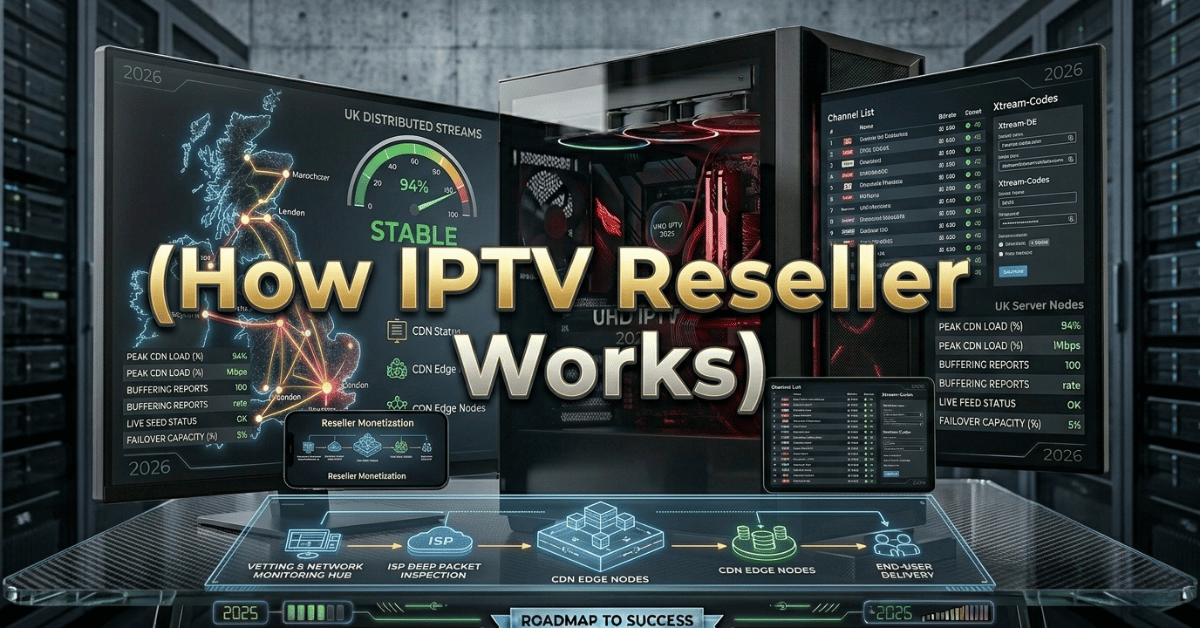
The enforcement landscape has matured considerably. Major UK broadcasters are no longer relying solely on court-ordered domain blocks, AI-driven deep packet inspection has entered operational deployment at the ISP level. In 2026, the pattern recognition targets stream signatures, not just IP addresses. A static server IP running high-volume UHD IPTV traffic generates a recognisable signature. Providers who aren’t rotating infrastructure or running streams through obfuscated relay layers are increasingly exposed.
For resellers, this translates to a practical responsibility: your provider’s ability to respond to enforcement action determines your uptime, not just their server capacity. When an IP block lands mid-match, how quickly can they pivot? Do they maintain warm standby IPs? Are M3U and Xtream Codes endpoints updated automatically in the panel, or does a human have to manually push new URLs to every active line?
These are not theoretical questions. In the past eighteen months I’ve watched three mid-size UK reseller operations collapse entirely, not because their providers were technically weak, but because they had no enforcement response infrastructure. First block, permanent downtime.
DNS poisoning is the secondary mechanism now running alongside IP blocking. Resellers whose customers rely on domain-based M3U links with no DNS fallback logic are one poisoning event away from total service failure. Push your provider on this, or choose one where it’s already solved.
Getting UHD IPTV Pricing Right: Where Most Resellers Lose Margin
Resellers consistently underprice UHD IPTV relative to its infrastructure cost, then wonder why churn is high and margins are thin. The instinct to compete on price against the cheapest panel in the market destroys the segment.
UHD IPTV Margin Formula:
Net Margin per Subscription = Sale Price − (Credit Cost + Support Load + Churn Provision)
If credits cost £2.50 per line, support averages £0.80 per subscriber monthly, and churn runs at 18%:
Minimum viable sale price = £2.50 + £0.80 + (£Sale Price × 0.18)
Solving: Sale price ≥ £4.02 just to break even. UHD premium justifies positioning at £8–£12 monthly, which is where sustainable margin lives.
Customers paying £12 for a UHD IPTV subscription that reliably delivers 4K sport on a Saturday afternoon don’t churn. Customers paying £4 for a service that half-works will never be loyal regardless of price.
Platforms like Smart IPTV Panel Reseller are structured specifically for resellers who want to operate in this premium tier, dedicated UHD infrastructure, proper credit allocation, and enforcement response capability built into the panel architecture rather than bolted on after the fact.
UHD IPTV Reseller Checklist: What to Confirm Before Going Live
Confirm provider uplink is 10Gbps+ with documented capacity per concurrent connection
Test UHD streams during a live sports peak window, not off-peak
Audit your customer device base for HEVC hardware decode compatibility
Establish failover node and confirm auto-trigger threshold with your provider
Price UHD IPTV at margin-positive levels, minimum £8/month for sustainable operation