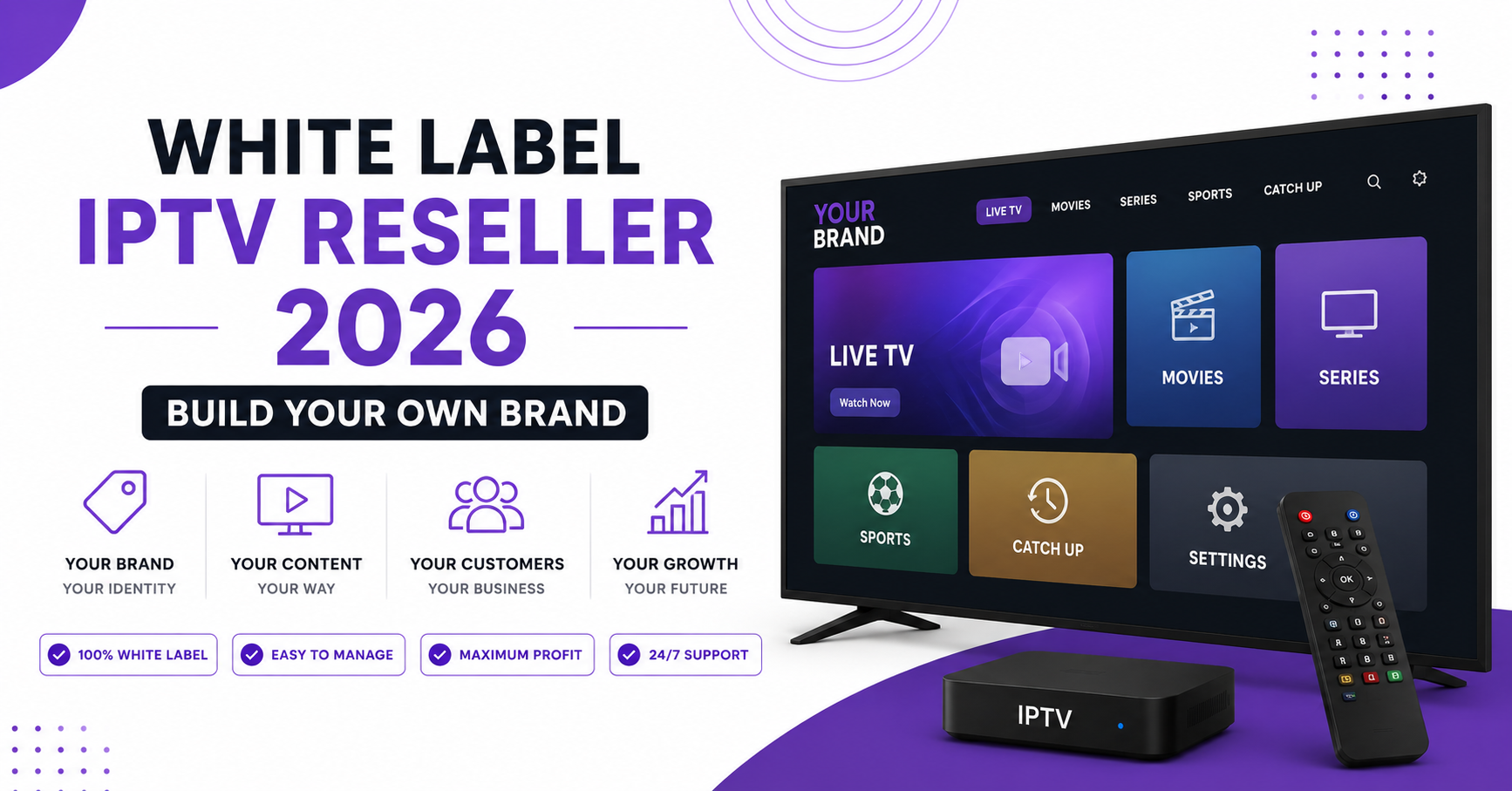
White Label IPTV Reseller 2026: Build Your Own Brand
Most people who jump into white label reselling think the hard part is finding a supplier. It isn’t. The hard part shows up three months later, when your logo is on an app that buffers during a Champions League semi-final and forty customers are messaging you at once — not the supplier, you. Your brand, your problem.
That’s the trade every white label IPTV reseller in 2026 makes whether they understand it or not. You’re not buying streams. You’re buying responsibility for someone else’s infrastructure and stamping your name on it.
The quick answer: becoming a white label IPTV reseller in 2026 means licensing a provider’s streaming infrastructure and panel, then selling it under your own brand, app, and pricing. It works — but only if the upstream infrastructure is genuinely redundant and you treat support as your core product. The single biggest failure cause isn’t competition or price. It’s choosing a backend with no failover and discovering it the night your customers do. Vet the infrastructure before the branding. Everything else is decoration.
The rest of this is the part nobody tells you before you’ve already paid for the setup.
What “White Label” Actually Buys You
Strip away the marketing and a white label arrangement is a licensing deal. The panel owner upstream runs the servers, the encoders, the content sources. You get a branded IPTV reseller panel, a custom app or player, your own domain, and the ability to issue panel credits to customers and sub-resellers. What you don’t get — and this catches new operators every time — is control over the thing that determines whether you keep customers: stream stability.
Here’s the distinction that matters in practice:
| What you control | What the upstream controls |
|---|---|
| Branding, app name, logo | Server uptime |
| Pricing and panel credits | DNS routing and failover |
| Customer support quality | Channel sources and EPG |
| Sub-reseller structure | Anti-blocking response |
| Marketing and trials | Capacity during traffic spikes |
Read that right column twice. Every item on it is a thing customers will blame you for when it breaks. A white label IPTV reseller carries the reputation risk for infrastructure they don’t operate. That asymmetry is the whole game.
Pro Tip:
Before signing any white label deal, ask the provider one question: “Show me what happens to a stream when your primary source drops.” If they can’t describe the failover path in plain language, they don’t have one. Walk away.
The Infrastructure Conversation Nobody Has Early Enough
A mistake we repeatedly see: new resellers spend two weeks perfecting their logo and ten minutes evaluating the backend. Then a major sports event arrives and the whole thing folds.
During one migration project a couple of seasons back, we watched a reseller move 600 subscribers onto a cheap white label panel because it was four dollars cheaper per credit. The panel ran on a single source with no backup uplink. The first Saturday of heavy fixtures, concurrent load spiked, the source choked, and roughly a third of his customers hit dead streams within the same hour. He lost about ninety of them inside two weeks. The math on that “saving” was catastrophic.
Cheap infrastructure and professional infrastructure look identical on a sales page. They diverge violently under load:
| Cheap backend | Professional backend |
|---|---|
| Single content source | Multiple redundant sources |
| No automatic failover | Failover within seconds |
| One uplink | Backup uplinks across providers |
| Buffers under concurrent load | Holds during traffic spikes |
| You find out it’s down from customers | Monitoring alerts before customers notice |
The difference shows up exactly when it costs the most — during the events that drive people to subscribe in the first place.
Why ISP Blocking Changed the Game in 2026
The blocking landscape isn’t what it was even two years ago. ISPs across the UK, Australia, and parts of North America have moved from crude IP blacklists to AI-assisted traffic fingerprinting that identifies streaming patterns by behaviour, not just by address. A static setup that worked last year quietly degrades this year.
What this means for a white label IPTV reseller is uncomfortable but simple: your provider’s response to blocking is now a feature you’re selling, even though you can’t see it. Providers who rotate domains, vary their delivery signatures, and route around throttling keep your customers connected. Providers who don’t will leave you explaining outages you can’t fix.
We noticed unusual ISP behaviour during last winter’s fixture congestion — certain streams degraded only during peak hours and only on specific carriers, which is the signature of throttling rather than a dead source. A reseller without an upstream that engineers around that pattern simply absorbs the churn.
Pro Tip:
Ask your provider how often they rotate delivery domains and whether they offer multiple connection methods. A backend that only works one way is a backend with one point of failure between your brand and a refund request.
The Economics Resellers Get Wrong
Most white label pricing models collapse because the operator priced for acquisition and forgot retention costs nothing until it costs everything.
Panel credits are cheap to issue. Support is not. The real cost structure of an IPTV business owner looks like this:
- Credit cost — what you pay the panel owner per line
- Support time — the hours per month per hundred subscribers, which scales faster than people expect
- Churn replacement — the marketing spend to replace every customer who leaves
- Refund leakage — chargebacks and refunds from instability you didn’t cause but own
After reviewing hundreds of support requests across reseller operations, the pattern is consistent: setup confusion and buffering generate roughly 70% of tickets. Both are front-loaded. A customer who gets a clean first 48 hours rarely contacts you again. A customer whose first weekend stutters becomes a permanent support burden or a refund.
Pro Tip:
Price in your support time, not just your credit cost. A credit reseller who sells at razor margins to undercut competitors is selling themselves a second unpaid job.
Building the Brand Layer That Survives Scrutiny
Branding is the part you actually control, so it’s worth doing properly. But “white label” tempts people into thinking a logo is a brand. It isn’t.
A durable white label IPTV reseller brand in 2026 has a few non-negotiables:
- A real domain and a working support channel that answers within hours, not days
- A clear, honest onboarding flow that prevents the buffering-and-confusion ticket flood
- Consistent app naming so customers know what they installed
- Trial handling that converts rather than leaks
One reseller lost customers not because his streams were bad but because his app was named one thing, his website another, and his support replied from a third identity. Customers couldn’t tell if they’d been scammed. Trust collapsed faster than any stream ever did.
Trial Conversion Is Where Brands Live or Die
Trial users rarely convert on stream quality alone — they convert on the experience around it. A trial that arrives with clear setup instructions, works on the user’s actual device, and is followed by a single well-timed message converts far better than a trial dropped into someone’s inbox with no guidance. The infrastructure gets them watching. The brand experience gets them paying.
A Practical Vetting Process Before You Commit
Here’s the sequence that separates operators who last from those who churn out within a year:
- Test under load, not at midnight. Run a trial during a live high-demand event. Empty-network performance tells you nothing.
- Map the failover. Make the provider explain, in words, what happens when a source drops. Vague answers mean no answer.
- Check device coverage. Confirm the white label app works cleanly on Firestick, Android TV, and the smart TVs your market actually owns.
- Probe the support chain. Send the provider a fake-urgent ticket before you sign. Their response time to you predicts your customers’ experience.
- Start small. Run 20–30 lines before migrating a base. Scale only after a full sports weekend without incident.
A reseller who runs this sequence rarely gets blindsided. One who skips it learns the same lessons by losing customers instead.
Pro Tip:
The best white label backends are usually not the cheapest and almost never the loudest advertisers. Reliability is quiet. The providers shouting about “8K” and “unlimited everything” are usually compensating for an infrastructure story they’d rather you didn’t ask about.
Where the Market Is Heading
The white label model is consolidating. As blocking gets more sophisticated and infrastructure costs rise, the gap between serious panel owners and weekend operators is widening. Smaller backends that can’t fund redundancy and anti-blocking engineering are quietly disappearing — sometimes overnight, taking their resellers’ customer bases with them.
For a white label IPTV reseller building in 2026, this is actually good news. The customers leaving collapsed cheap services are looking for someone reliable. If your brand sits on genuinely redundant infrastructure and your support actually answers, you inherit them. The operators who survive the next two years won’t be the cheapest. They’ll be the ones whose customers never had a reason to leave.
If you want a working reference point for how a customer-facing IPTV brand presents pricing, onboarding, and support, it’s worth studying how established operations like britishseller.co.uk structure their offering before building your own.
Frequently Asked Questions
What does a white label IPTV reseller actually sell in 2026?
A white label IPTV reseller in 2026 sells a streaming service under their own brand, app, and pricing while licensing the underlying infrastructure from an upstream panel owner. You control branding, support, and customer relationships; the provider runs servers and content delivery. Your value is reliability and service, not the streams themselves.
How much does it cost to start as a white label IPTV reseller?
Startup costs vary widely, but the meaningful expense isn’t the panel credits — it’s the time and systems for support and onboarding. Many start with a modest credit package and a domain. The hidden cost is churn replacement when cheap infrastructure fails, which routinely dwarfs whatever you saved on credit pricing.
Is becoming a white label IPTV reseller in 2026 still profitable?
Yes, but margins now favour operators who prioritise reliability over price. As weak backends collapse under tougher ISP blocking, customers migrate toward dependable brands. A white label IPTV reseller with redundant infrastructure and responsive support can absorb that migration. Those competing purely on lowest price tend to churn out within a year.
What’s the biggest mistake new resellers make?
Choosing a backend on price instead of testing it under real load. Cheap and professional infrastructure look identical on a sales page and diverge violently during sports-event traffic spikes. Resellers who skip load-testing discover the failure the same night their customers do — and lose them faster than any saving justified.
How do I keep customers from churning?
Most churn is front-loaded in the first 48 hours. Setup confusion and early buffering drive roughly 70% of support tickets. A clean onboarding flow, device-specific instructions, and infrastructure that holds during the first weekend prevent most cancellations before they form.
Do I need technical skills to run a reseller panel?
Basic comfort with a reseller panel, issuing panel credits, and troubleshooting common device setups is enough to start. Deep networking knowledge isn’t required because the upstream handles infrastructure. What you genuinely need is patience for support and the judgement to vet a provider properly before committing customers.
Can I build sub-resellers under my white label brand?
Yes. Most reseller panels let you create sub-reseller accounts and allocate panel credits down a hierarchy. This scales reach but multiplies support and reputation risk — every sub-reseller’s failures still reflect on your brand. Vet and support sub-resellers as carefully as you’d want your own provider to support you.
Execution Checklists
For Subscribers
- Test any service during a live event before paying for a long term
- Confirm it works on your actual device before committing
- Keep your first payment short until stability is proven
- Save your provider’s support contact before you need it
For Resellers
- Load-test the white label backend during a real sports weekend before migrating
- Make the provider explain their failover path in plain words
- Price in support time, not just panel credits
- Build one consistent brand identity across app, site, and support
- Run 20–30 lines before scaling a full customer base
For Sub-Resellers
- Verify your panel owner’s infrastructure independently — don’t take it on faith
- Hold a small credit buffer so you’re never caught unable to renew customers
- Document setup steps once so onboarding doesn’t eat your time
- Escalate upstream issues fast instead of absorbing the blame silently
Conclusion
Becoming a white label IPTV reseller in 2026 is a genuinely viable business, but it rewards the opposite instinct most newcomers arrive with. The winners aren’t the ones with the slickest logo or the lowest price. They’re the ones who treated infrastructure vetting as step one and branding as step two. A white label IPTV reseller lives or dies on a backend they don’t own, which is exactly why choosing that backend carefully matters more than any other decision you’ll make.
Get the infrastructure right, build a brand that answers when customers call, and let the cheap operators churn themselves out of the market.
The single lesson worth keeping: in white label reselling, your brand absorbs every failure of infrastructure you didn’t build. Choose that infrastructure as if your reputation depends on it — because the moment your logo goes on the app, it does.