The Panel That Looks Smart But Behaves Stupid
Most resellers launch a Smart IPTV Reseller Panel thinking the hard work is done once the credits are topped up and the links are handed out. That assumption costs them customers, credibility, and eventually the entire business.
A Smart IPTV Reseller Panel is not just a dashboard for distributing streams. It is a live infrastructure node with dependencies — uplinks, DNS resolution paths, HLS delivery chains, and a credit economy that punishes waste faster than most beginners expect. The difference between a panel that generates passive income and one that generates support tickets at 2 AM is almost never the price point. It is how the operator understands the machine underneath.
In 2026, with AI-driven ISP blocking becoming standard practice across major telecoms, the reseller who treats their Smart IPTV Reseller Panel as a passive tool is already losing ground. The operators who win are the ones who run it like a network engineer — monitoring load, rotating DNS entries, and building backup uplinks before they are needed, not after the first outage.
This guide is not for someone looking for a product review. It is for resellers who have had their panel go dark during a live sports window and needed answers fast.
Pro Tip: Never treat your Smart IPTV Reseller Panel login as the finish line. The panel is the cockpit. You still have to fly the plane.
Why DNS Poisoning Kills More Panels Than Server Failures
Here is something most panel sellers will never tell you: the majority of stream failures that get blamed on “server downtime” are actually DNS poisoning events. ISPs across the UK and EU have been deploying deep packet inspection combined with DNS-level blocking since late 2024. By 2026, the enforcement has become semi-automated — AI systems flag stream sources and push blocking rules to DNS resolvers within hours of detection.
What does this mean for your Smart IPTV Reseller Panel? It means your streams may appear live on the server side while being completely unreachable to subscribers whose ISPs have poisoned the resolution path. Your panel dashboard shows green. Your customers see a black screen. You spend three hours blaming the provider before someone on your network tests through a VPN and confirms the issue is DNS-side.
The fix is not complicated, but it requires proactive setup:
- Configure your subscribers to use alternative DNS resolvers (not default ISP-assigned ones)
- Maintain at least two resolution paths in your panel settings where supported
- Ask your panel provider whether they rotate server-side DNS records — this is now a non-negotiable feature in 2026
- Log outage patterns — if they cluster around certain ISPs or regions, DNS is almost certainly the root cause
| Issue Type | Visible Symptom | Root Cause |
|---|---|---|
| DNS Poisoning | Black screen, portal loads | ISP-level block on stream resolution |
| Server Overload | Buffering, pixelation | Concurrent connection limit hit |
| HLS Latency | Delayed audio sync | Segment delivery chain too slow |
| Credit Drain | Unexpected balance drop | Ghost connections or leaked credentials |
Understanding this table is the difference between a reseller who fixes problems and one who just restarts things and hopes.
Load Handling: The Silent Reason Your Smart IPTV Reseller Panel Breaks During Peak Hours
Ask yourself honestly — when was the last time you stress-tested your panel during a peak load window? Most operators using a Smart IPTV Reseller Panel have never done it deliberately. They find out the hard way, usually during a premium sports event, when every connection the panel can handle is already in use and new subscribers cannot get in.
Load handling is not a hardware problem you can throw money at without understanding the architecture. A Smart IPTV Reseller Panel typically distributes load across a CDN or a set of transcoding relays. When concurrent connections spike — say, 800 users hitting a premium sports channel simultaneously — the panel either routes overflow to a backup relay or it starts dropping frames.
The panels that handle this well are built with load balancing baked in. The ones that fail are built around a single origin source with no failover logic.
What to audit on your current panel:
- Maximum concurrent connections per stream category (SD, HD, FHD, 4K)
- Whether the panel provider uses edge nodes or a central relay
- Whether backup uplink servers activate automatically or require manual switching
- Your actual subscriber count versus your panel’s stated connection ceiling
Pro Tip: If your panel provider cannot tell you their load balancing architecture in plain language, they either do not have one or do not understand it. Both answers should concern you.
The Credit Economy Is More Fragile Than You Think
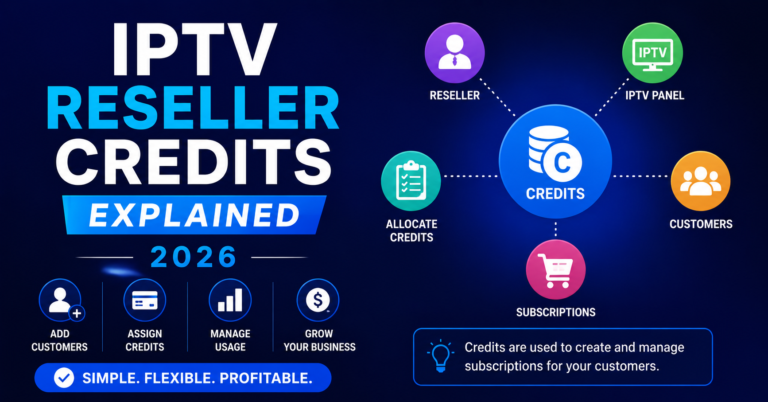
Credits are the currency of the Smart IPTV Reseller Panel model — and they are far easier to lose than most new operators realise. Ghost connections, credential leaks, and reseller account mismanagement can drain a credit balance in ways that do not immediately show up as obvious losses.
A ghost connection happens when a stream session is opened but never properly closed — either because the subscriber’s app crashed, or because the device lost signal mid-session. The panel keeps the connection alive, burning credits, while the user has already moved on. Multiply this across fifty active subscribers and the drain is significant within weeks.
Credential leaks are worse. If a reseller shares login credentials carelessly — or if an end user shares their stream URL in a group chat — you end up with unauthorised connections pulling load from your allocation without generating any revenue.
Credit protection checklist:
- Enable simultaneous connection limits per subscription (usually 1 or 2 max)
- Audit active connections weekly — any session open longer than 8 hours continuously should be flagged
- Avoid issuing trial credits without a connection cap
- Never let sub-resellers operate without their own isolated credit pool
Choosing Between White-Label and Branded Panel Setups
Not every reseller running a Smart IPTV Reseller Panel has considered which panel model actually suits their business structure. The choice between white-label operation and branded reselling is not cosmetic — it carries infrastructure, liability, and scalability implications that affect how the business grows.
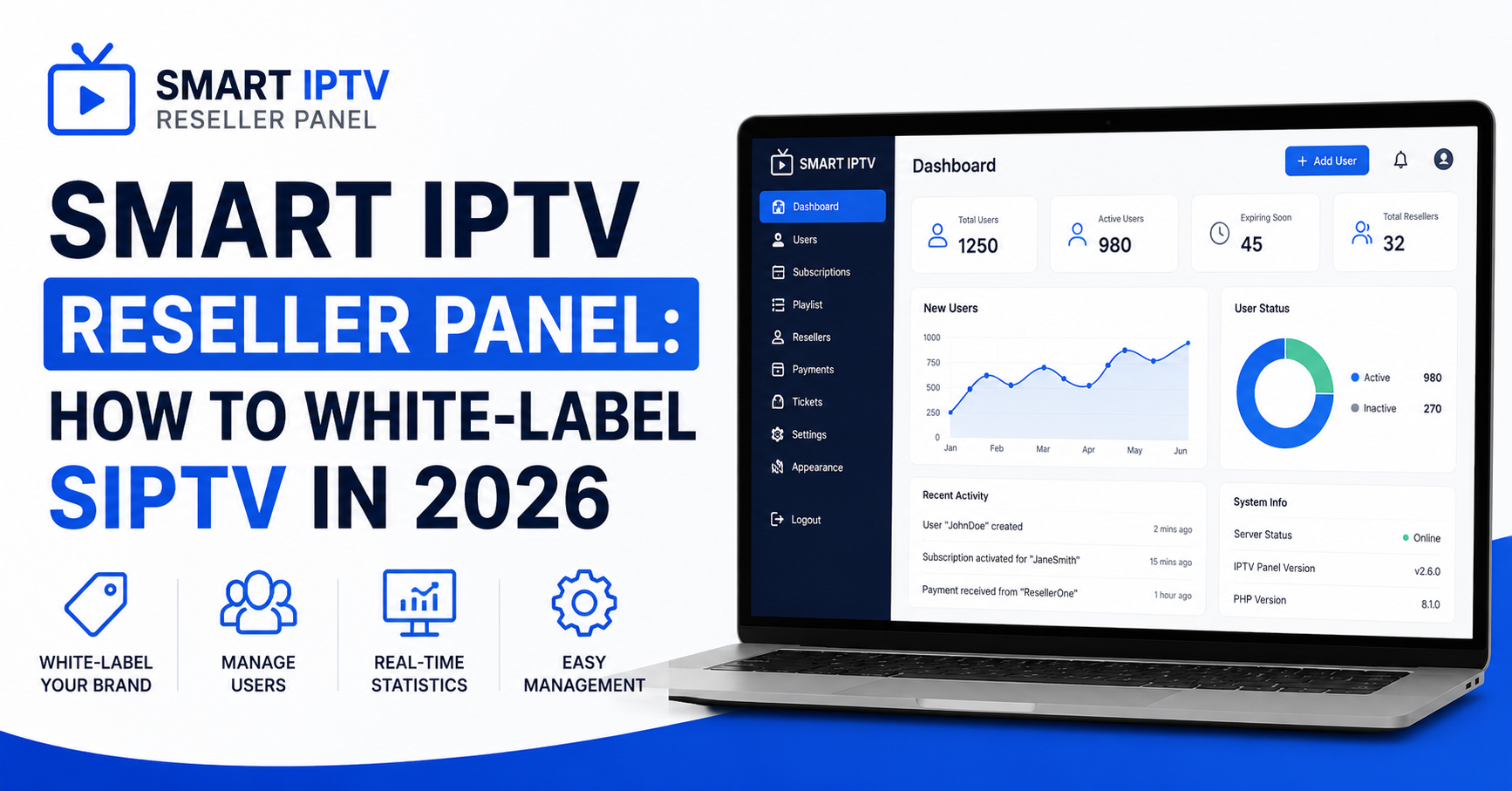
A white-label Smart IPTV Reseller Panel lets you present the service under your own domain and branding. Customers see your name, your logo, your support contact. The backend is managed by your panel provider. This is the right model if you are building a customer-facing brand with long-term retention as the goal.
A branded reseller setup — where you operate under the panel provider’s ecosystem without custom branding — is leaner and faster to launch. The trade-off is brand equity. Every satisfied customer you build is partially the provider’s customer, not yours.
| Factor | White-Label Panel | Branded Reseller Setup |
|---|---|---|
| Brand ownership | Full | Partial or none |
| Setup complexity | Higher | Low |
| Customer loyalty | Built to your brand | Split with provider |
| Infrastructure control | Moderate | Limited |
| Recommended for | Scaling operators | Beginners testing market |
The Smart IPTV Reseller Panel model works in both configurations — but the operator who does not think about this decision early usually ends up rebuilding their customer communication structure later at significant cost.
ISP Blocking in 2026: AI Enforcement Is Not a Threat. It Is Already Here.
This section is not speculation. AI-assisted stream detection is operational across major telecoms in the UK, EU, and increasingly across US carriers. The detection mechanism works by identifying traffic patterns characteristic of unauthorised stream delivery — sustained high-bandwidth UDP or HLS payloads from known IPTV infrastructure IPs — and cross-referencing them against enforcement databases updated in near real-time.
What changed in 2025 and into 2026 is the automation of the response. Previously, blocking required a legal order or a manual update to ISP-level firewall rules. Now, AI systems can flag, escalate, and block at speed that leaves resellers reacting rather than anticipating.
For Smart IPTV Reseller Panel operators, this means:
- Panel provider IP ranges are identified and targeted faster than ever
- Backup uplink servers are no longer optional infrastructure — they are survival infrastructure
- Customer-facing VPN guidance has become a standard part of onboarding, not an afterthought
- Panels that rotate server IPs on a rolling basis are significantly more resilient than those with static infrastructure
Pro Tip: Build a two-tier backup system — a secondary panel URL on a different IP range, plus a subscriber-side DNS fallback guide. Customers who can troubleshoot with a two-step process stay. Customers who hit a dead end leave and do not come back.
Panel Management at Scale: What Changes After 100 Resellers
Running a Smart IPTV Reseller Panel with ten sub-resellers beneath you is manageable with basic organisation. Running one with over a hundred is a fundamentally different operation. Most resellers who cross that threshold without adjusting their management approach create problems they cannot see until they become crises.
At scale, the key pressure points shift:
Credit reconciliation becomes a daily task rather than a weekly one. Sub-resellers who run out of credits at inconvenient times will expect immediate top-up — and if your panel does not support automated low-balance alerts, you will be fielding emergency messages around the clock.
Stream quality monitoring can no longer be reactive. At scale, you need to know about a degraded channel before thirty resellers start escalating tickets. Panel-level monitoring dashboards, where available, should be checked at minimum twice daily during high-traffic periods.
Reseller communication structure needs formalisation. A WhatsApp group works at ten resellers. At a hundred, it becomes noise. A proper tiered support chain — where sub-resellers have designated contacts and escalation paths — protects your time and your panel’s reputation.
The Smart IPTV Reseller Panel model rewards scale when the operator scales their systems alongside their headcount. It punishes those who treat a larger network as just a bigger version of a smaller one.
Churn Psychology: Why Subscribers Leave and What the Panel Tells You
Customer churn in the IPTV reseller space is often blamed on stream quality. That explanation is accurate roughly half the time. The other half, the subscriber was never going to stay regardless — and the signals were visible in the panel data beforehand.
A Smart IPTV Reseller Panel captures connection logs, active session data, and device access patterns. Operators who read this data can identify churn risk before the cancellation request arrives.
Patterns to watch for:
- Subscribers who connect fewer than five times per week on a service they originally used daily — engagement has dropped, often because of a quality experience that did not meet expectations
- Devices switching repeatedly between connection attempts without completing — app or DNS issue the subscriber has not reported yet
- Accounts showing connections from multiple geographic regions simultaneously — shared credentials, which will eventually exceed the connection limit and generate a frustration-driven cancellation
The Smart IPTV Reseller Panel is a data source, not just a billing tool. Resellers who treat it purely transactionally leave retention intelligence on the table.
Frequently Asked Questions
What makes a Smart IPTV Reseller Panel different from a standard reseller panel?
A Smart IPTV Reseller Panel typically includes advanced management features such as automated credit tracking, real-time connection monitoring, multi-tier reseller hierarchy support, and load-aware stream routing. Standard panels often lack the infrastructure visibility and sub-reseller management depth needed to operate at scale without constant manual oversight.
How many concurrent connections should a Smart IPTV Reseller Panel support before I need to upgrade?
It depends on your active subscriber base, not your total subscription count. A realistic benchmark is 60–70% of subscribers active simultaneously during peak hours. If your panel’s connection ceiling sits below that threshold, you will experience visible drops during premium content windows. Upgrade before you hit the ceiling, not after.
Is a Smart IPTV Reseller Panel legal to operate in the UK?
The legal position around IPTV reselling in the UK is nuanced. Distributing streams of content without authorisation from rights holders carries legal risk. Operators should research the current regulatory environment thoroughly and consult a legal professional. This article is informational and does not constitute legal advice.
Why do my subscribers lose connection even when the panel dashboard shows all streams active?
This is almost always a DNS poisoning or local ISP-level blocking issue. The panel sees the stream as live because it is — on the server side. But the subscriber’s ISP is intercepting or blocking the resolution path before the stream reaches the device. The fix involves redirecting subscribers to alternative DNS resolvers and confirming the issue through VPN testing.
Can I run multiple sub-reseller tiers under one Smart IPTV Reseller Panel account?
Most Smart IPTV Reseller Panel providers support at least two tiers — the primary reseller and their sub-resellers. Some platforms support three or more tiers. The key is whether each tier has isolated credit pools and independent connection limits. Without isolation, a single sub-reseller mismanaging their accounts can affect your entire panel’s performance.
What is the most common reason credit balances drop faster than expected?
Ghost connections and credential sharing are the two primary causes. Ghost connections occur when sessions fail to close properly after a subscriber stops watching. Credential sharing happens when subscribers distribute their stream URLs or login details. Both issues can be mitigated by enabling strict simultaneous connection limits at the subscription level.
How should I onboard new sub-resellers to my Smart IPTV Reseller Panel?
Never hand over credentials without a structured onboarding process. Provide documentation covering: connection limits per subscription, how to manage their own sub-accounts, support escalation procedures, and what constitutes acceptable use. Resellers who are not properly onboarded generate disproportionate support load and are more likely to misuse credits.
What backup infrastructure should every Smart IPTV Reseller Panel operator have in place?
At minimum: a secondary panel URL on a different IP range, an alternative DNS resolver recommendation for subscribers, and a documented failover procedure. Backup uplink servers that activate automatically are preferable to manual switching. In 2026’s AI-enforced blocking environment, backup infrastructure is not a luxury — it is basic operational continuity.
Reseller Success Checklist
Infrastructure
- Confirm your Smart IPTV Reseller Panel provider uses load balancing across multiple relay nodes
- Set up a secondary panel URL on a different IP range before you need it
- Test backup uplink server activation — do not assume automatic failover works until you have verified it manually
DNS and Blocking
- Prepare a subscriber-facing guide for switching to alternative DNS resolvers
- Log outage patterns by ISP and region to identify DNS poisoning versus server failure
- Implement VPN compatibility testing as part of your onboarding flow for new subscribers
Credit and Connection Management
- Set simultaneous connection limits on every subscription tier — no exceptions
- Audit ghost connections weekly and build a cleanup protocol
- Isolate sub-reseller credit pools so one operator’s misuse cannot drain shared allocation
Scaling Operations
- Build a tiered support structure before your sub-reseller count exceeds twenty
- Enable automated low-credit alerts on every sub-reseller account
- Review panel monitoring dashboards twice daily during peak content periods
Brand and Retention
- Treat your Smart IPTV Reseller Panel data as a churn-prediction tool, not just a billing record
- Flag accounts with sharply declining weekly connection counts — reach out before they cancel
- Document your escalation procedure and share it with all sub-resellers in writing
For resellers looking for a Smart IPTV Reseller Panel setup that comes with genuine infrastructure support rather than just login credentials, British Seller offers a tested UK IPTV reseller panel ecosystem built for operators who are serious about uptime and scale.